Saint Francis of Assisi
| Collection: | Saints in Bronze (Antonio Oteiza) |
| Author: | Fr. Antonio Oteiza |
| Inventory Number: | MCO-AO-RE-00053 |
| Type: | Relief |
| Location: | Cataloguing Room |
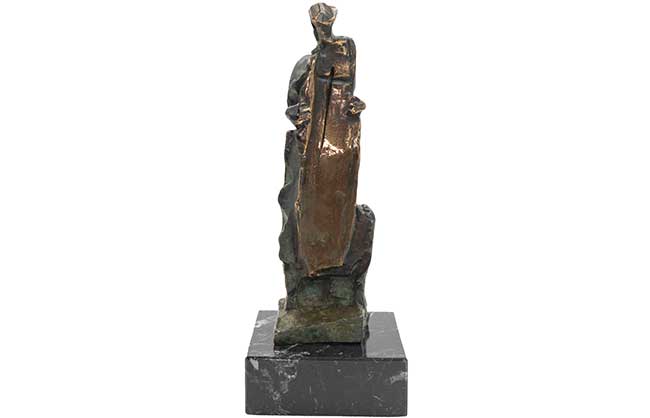
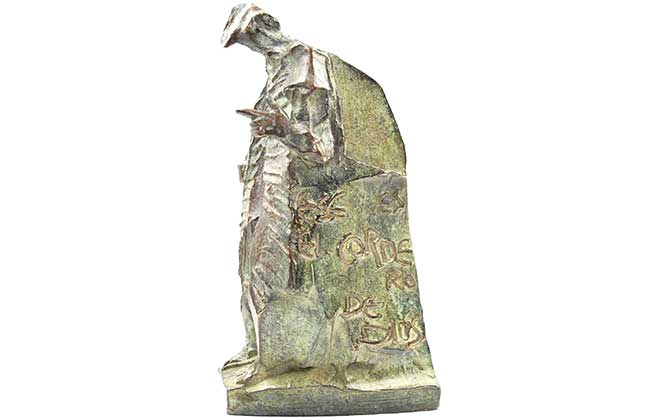
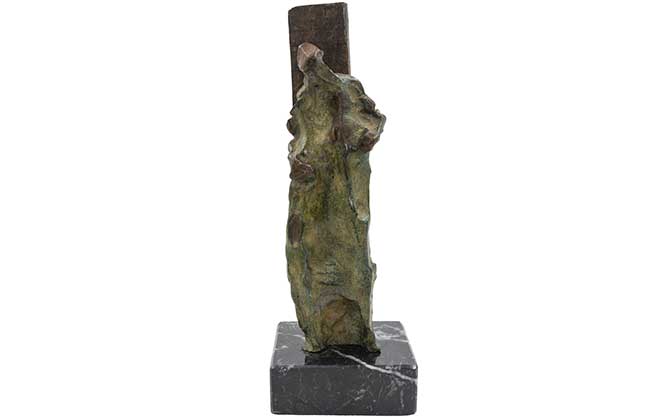
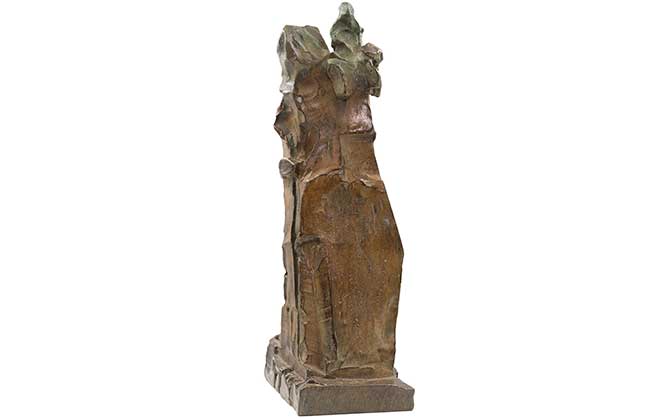
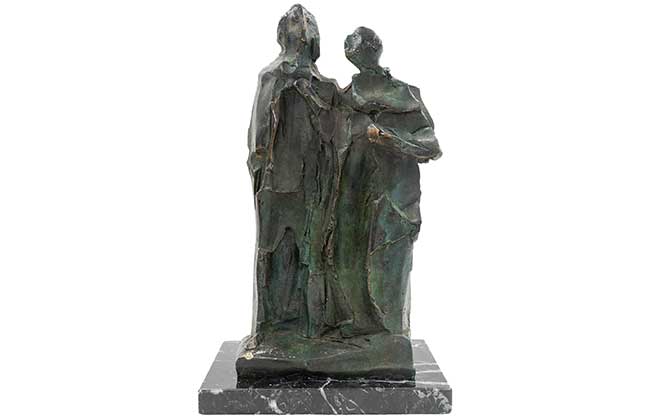
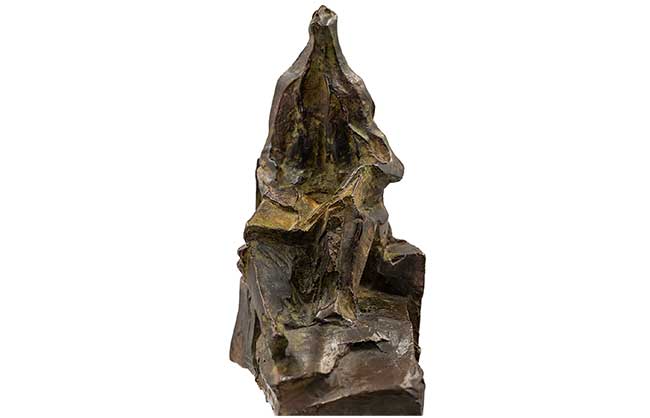
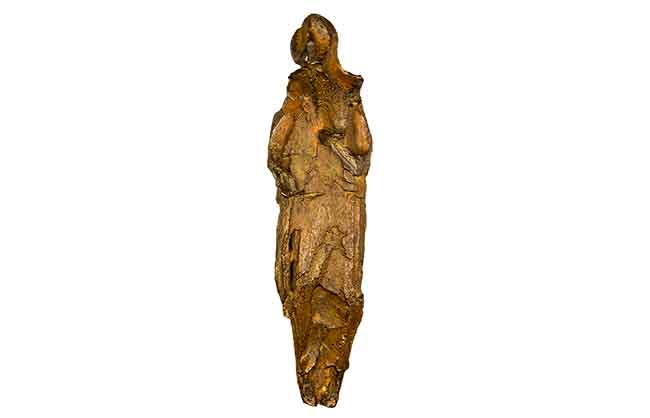
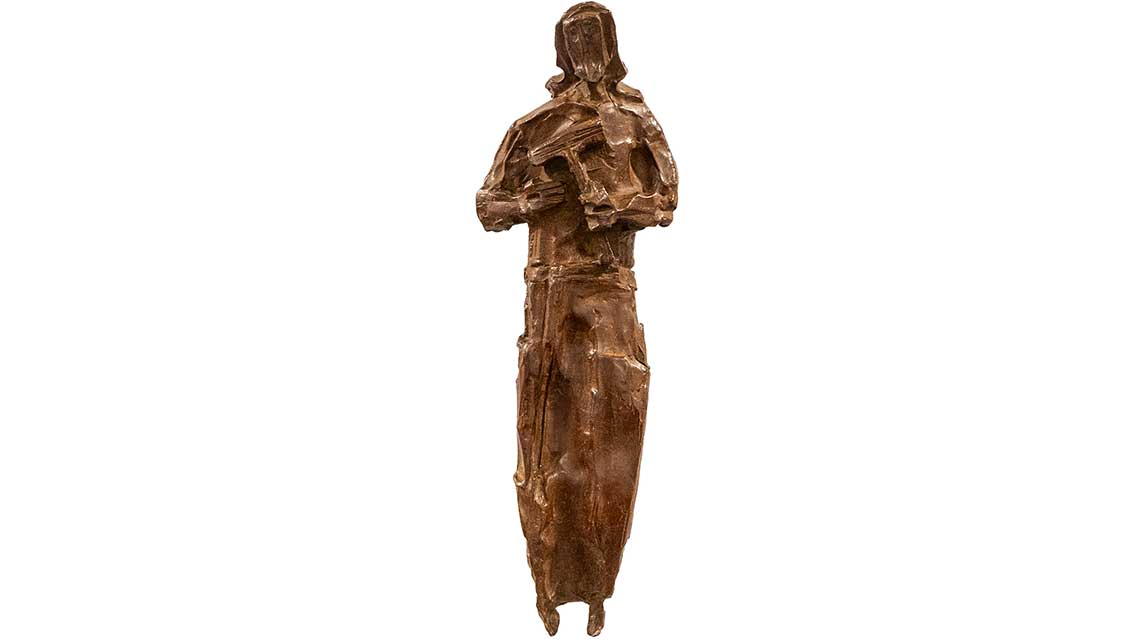
| Characteristics: | Saint Francis of Assisi is a narrow bronze relief with a strongly vertical format, mounted on a wooden support. The figure is not enclosed within a rectangular plaque; its own irregular and autonomous outline defines the limits of the composition. The body is constructed through broad planes, changes in thickness and fragments of material that replace conventional anatomical description. The shoulders open out in the upper section, while the habit descends as a continuous form that gradually narrows towards the feet. The face, framed by the hood, is rendered with very few features. The arms converge towards the centre of the torso, where the hands hold a cross-shaped form integrated into the composition. At the waist, the Franciscan cord is discreetly suggested, providing one of the saint’s essential identifying signs. The patina is restrained, combining browns, dark earth tones and coppery reflections. Light gathers on the most projecting areas — the face, hands, cross and edges of the habit — while the recesses and folds retain deeper tonalities. |
| Artwork: |
Click to enlarge |
| Description: |
Antonio Oteiza reduces the image of Saint Francis to a few essential elements: the habit, the cord, the cross and an attitude of profound inwardness. He does not represent a particular event from the saint’s life, nor does he turn to the miraculous episodes traditionally associated with him. The work centres instead on what defined his existence: the desire to live the Gospel through poverty, fraternity and identification with Christ. The pronounced verticality governs the entire composition. The body rises as a narrow, ascending and almost column-like form, conveying firmness without becoming rigid. The slight inclination of the head and the movement of the arms towards the chest introduce an inner tension that animates the frontal stillness. The face offers little individual detail. Oteiza does not seek to create a physical portrait of Francis, but to express a way of being. The lowered head, restrained shoulders and gathered hands turn the figure into a silent presence, defined more by attitude than by facial likeness. The expressive centre lies at the chest. Arms, hands and the cross-shaped element converge there. The cross is neither raised nor displayed before the viewer as an emblem; it remains closely bound to the body. This proximity transforms the attribute into an inner reality: Francis does not merely hold the cross, but seems to have made it part of himself. The habit occupies almost the entire work and absorbs much of the anatomy. Its broad surfaces, fractured planes and irregularities turn the garment into the true structure of the figure. The individual body recedes beneath an austere form that evokes Franciscan self-emptying and the rejection of all that is superfluous. The surface has not been smoothed to create an idealised image. Incisions, cracks, abrupt folds and concentrations of material preserve the energy of the modelling. The figure seems to emerge from bronze that remains rough and resistant. This material harshness does not diminish the spiritual dimension of the relief; it makes it more human. Oteiza does not depict a holiness untouched by suffering or vulnerability, but a transformation that takes place within them. Franciscan poverty is not reduced to the absence of possessions: it becomes inner freedom and a way of making room for God and for closeness to others. The warm patina supports this interpretation without introducing strong chromatic contrasts. Browns and copper tones unify the figure, while light appears intermittently on the hands, face and cross. These reflections guide the eye from the identity of the saint towards the spiritual core of the composition. The wooden support establishes a contrast between two different materials. Against the density and permanence of bronze, the wood provides an organic and warmer background. The silhouette therefore retains its autonomy and acquires a presence close to sculpture in the round, while remaining conceived for frontal viewing. Saint Francis founded the Order of Friars Minor and became the spiritual root of a broad religious family that also includes the Capuchins. His influence rests not only on teaching, but on the radical way in which he turned the Gospel into a form of life: closeness to the poor, fraternity, reconciliation, care for creation and trust in God. Antonio Oteiza condenses that legacy into an image of exceptional formal economy. He needs neither a crowd, a landscape nor a biographical scene. A stripped-down body, hands that hold and a cross absorbed into the material are enough. Saint Francis of Assisi presents holiness without distance or grandeur. The figure does not impose itself; it remains present. Through its verticality, silence and formal poverty, the work recalls that Francis’s true greatness lay in making himself lesser, recognising Christ in the most vulnerable and transforming faith into fraternity. |