Saint Christopher
| Collection: | Saints in Bronze (Antonio Oteiza) |
| Author: | Fr. Antonio Oteiza |
| Inventory Number: | MCO-AO-ES-00017 |
| Type: | Sculpture |
| Location: | Cataloguing Room |
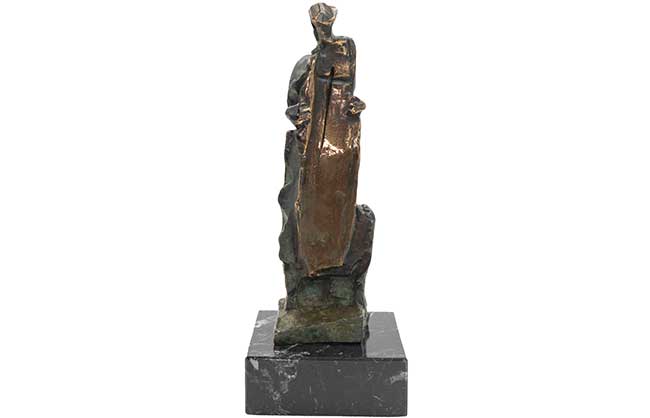
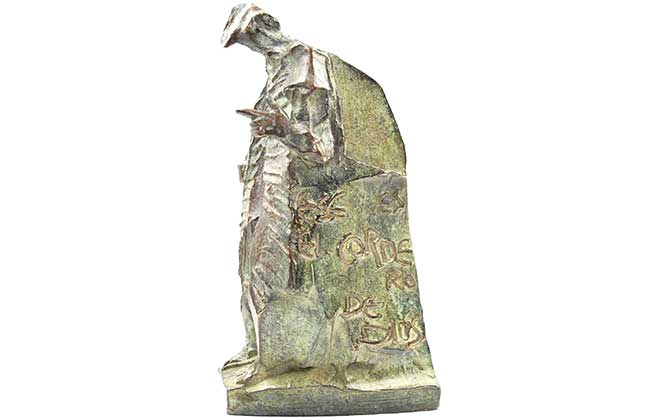
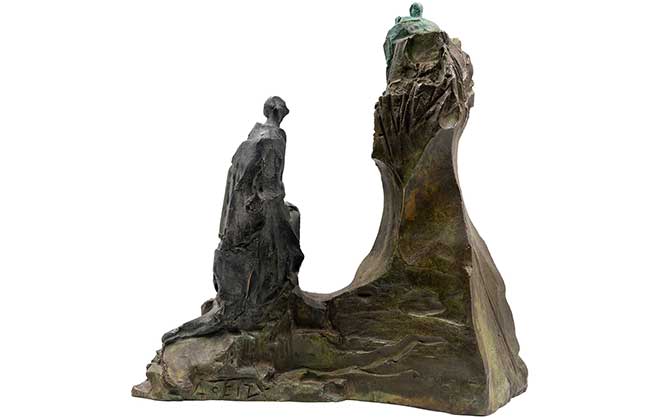
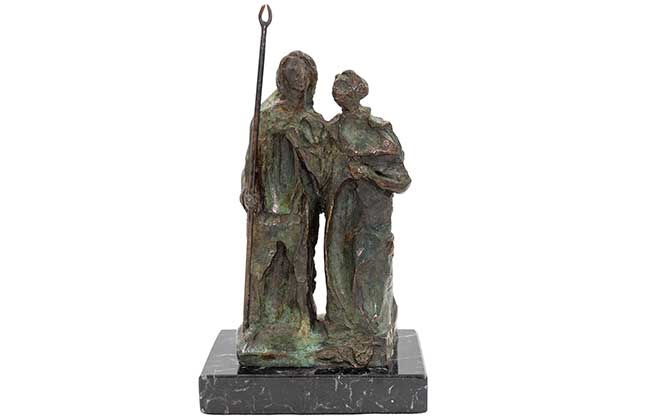
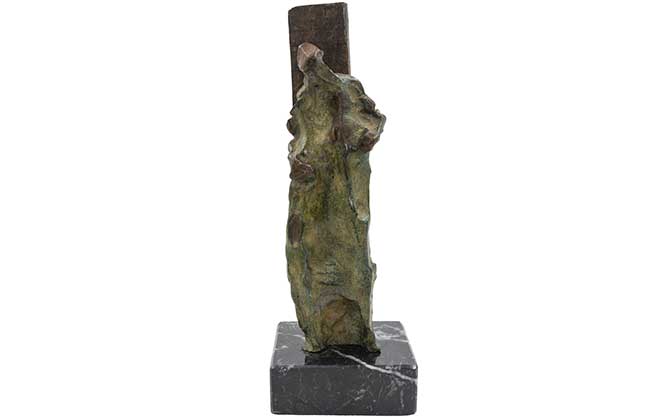
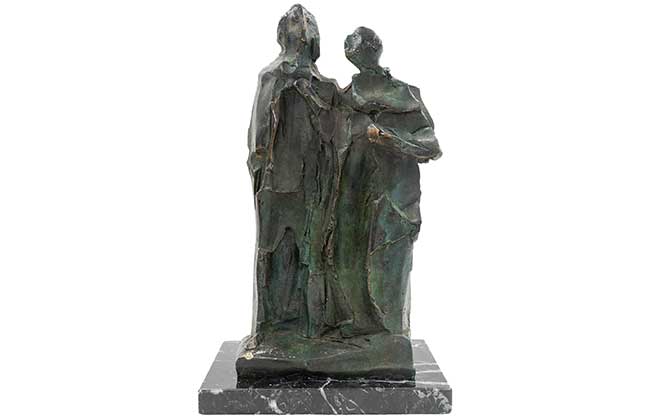
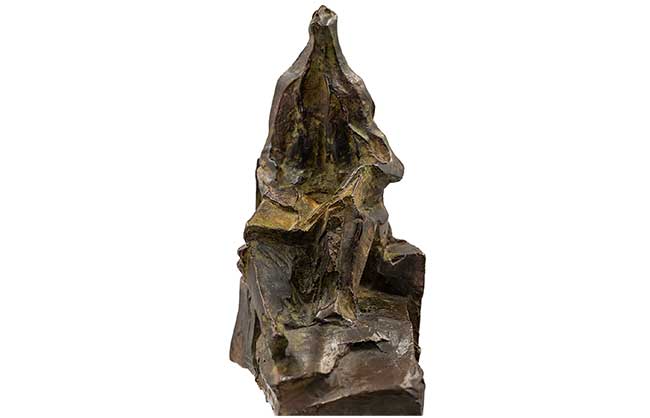
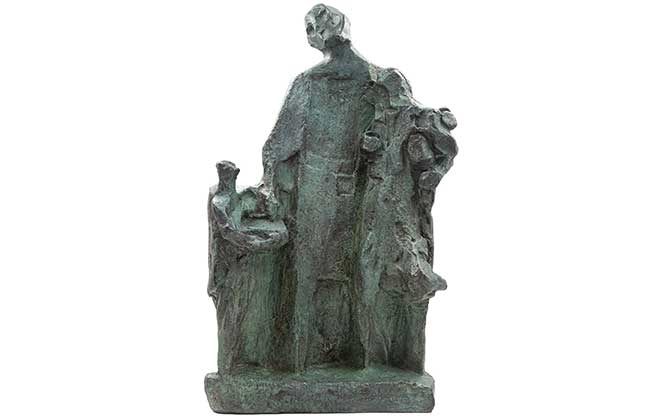
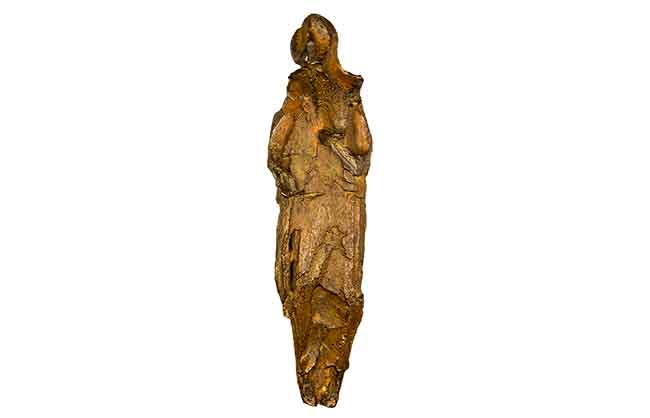
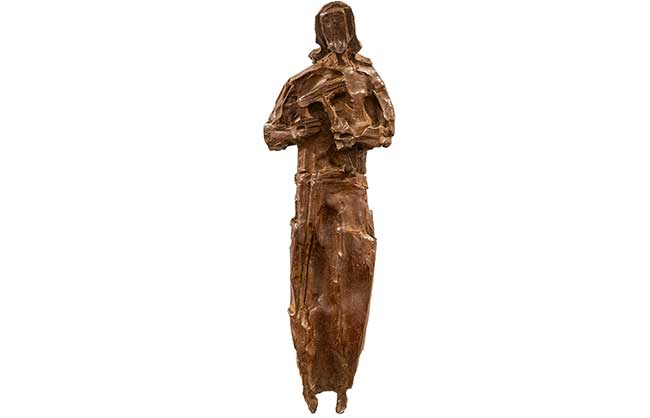
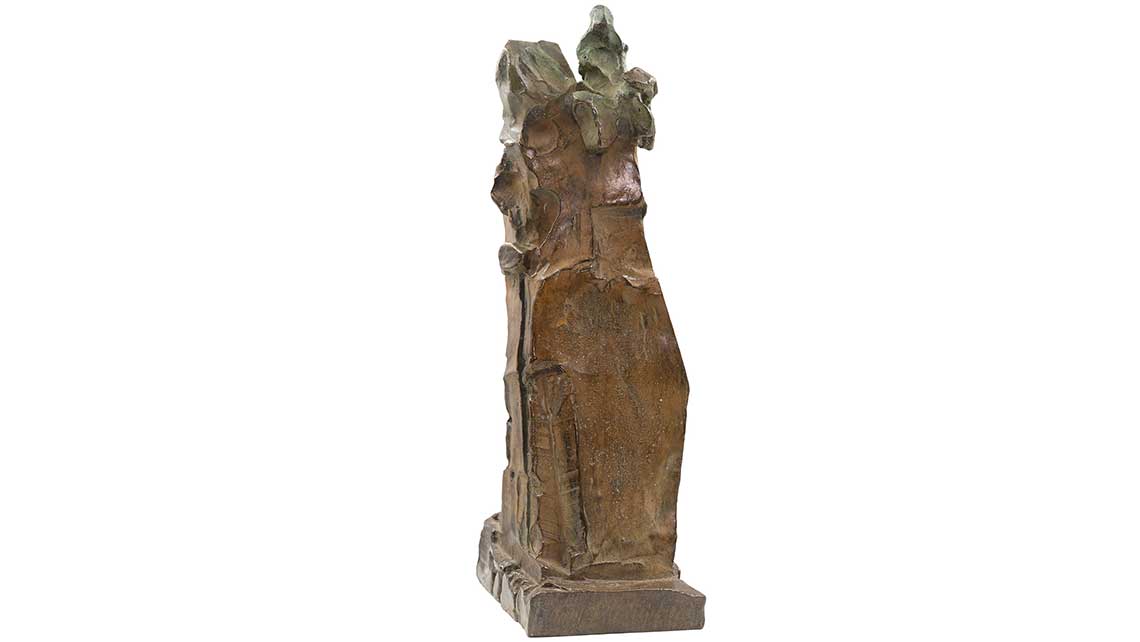
| Characteristics: | Saint Christopher is a freestanding bronze sculpture built around a compact, strongly vertical composition. The saint occupies most of the structure, while the Christ Child rises above his shoulders as both the physical and symbolic culmination of the work. Oteiza simplifies the anatomy and merges body, drapery and surrounding space into a single sculptural mass. Broad planes, cavities, incised marks and projecting forms animate the surface. The patina is dominated by brown and ochre tones with greenish nuances, reinforcing the depth of a work whose structure changes significantly as the viewer moves around it. |
| Artwork: |
Click to enlarge |
| Description: |
According to Christian tradition, Christopher helped travellers cross a river. One day, he carried a child whose weight grew heavier with every step. Only when they reached the other side did he understand that he had carried Christ and, symbolically, the weight of the world. Antonio Oteiza does not illustrate that story in detail. There is no clearly described river, landscape or crossing. Instead, he concentrates on the core of the legend: the experience of bearing a load whose true significance is revealed only through the act of carrying it. The body of Saint Christopher rises broad, heavy and almost architectural. It is neither heroically idealised nor naturalistically described. Body, clothing and supporting structure merge into a dense vertical form, whose slight inclination conveys the effort of moving forward. The saint seems to carry the Child with his entire body, not simply on his shoulders. The Christ Child emerges at the top of the composition among the volumes of the larger figure. His smaller scale does not diminish his importance. On the contrary, his elevated position establishes the hierarchy of the scene. A physical burden is transformed into a spiritual revelation. The sculpture becomes especially rich from the side. Cavities, projections and shifting planes reveal a structure far more complex than the frontal view initially suggests. From the rear, the narrative becomes less explicit and the work approaches a closed, almost abstract monumental form. This changing perception is fundamental to the piece. Oteiza requires the viewer to move around it and gradually discover the relationship between the one who carries and the one who is carried. The meaning is not delivered in a single image; it emerges through mass, void and movement in space. In Saint Christopher, burden does not appear as defeat. It bends and tests the body, but it also gives the figure its purpose. Oteiza turns a Christian legend into a broader reflection on responsibility, service and the human capacity to carry something whose true value is only understood along the way. |