Saint James
| Collection: | Saints in Bronze (Antonio Oteiza) |
| Author: | Fr. Antonio Oteiza |
| Inventory Number: | MCO-AO-RE-00015 |
| Type: | Relief |
| Location: | Cataloguing Room |
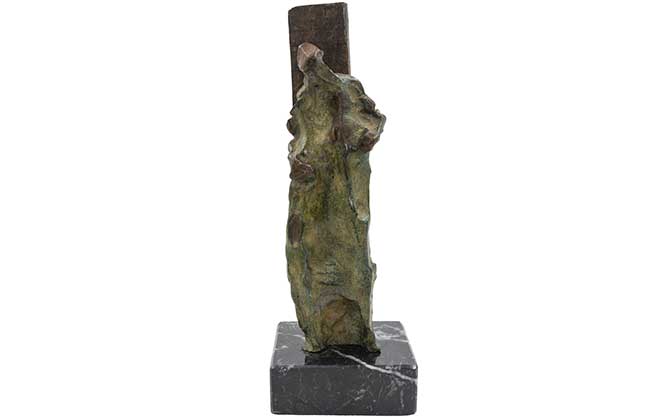
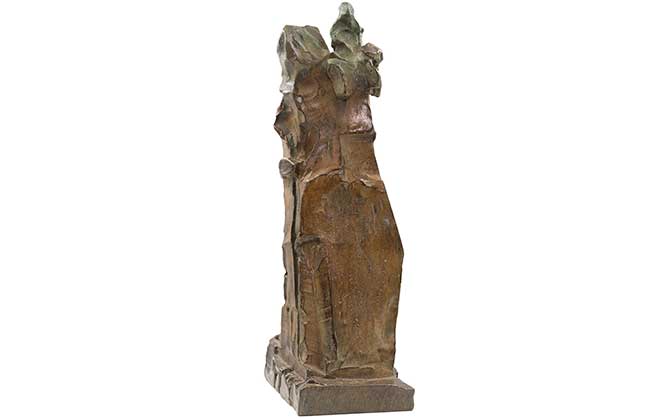
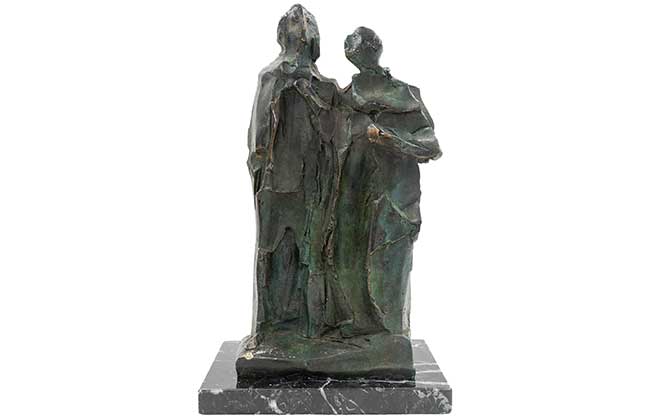
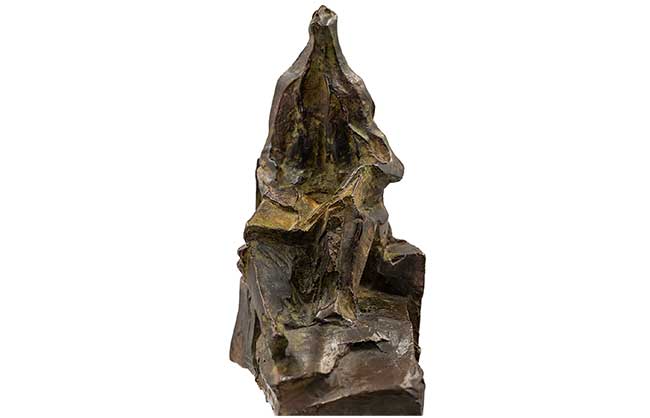
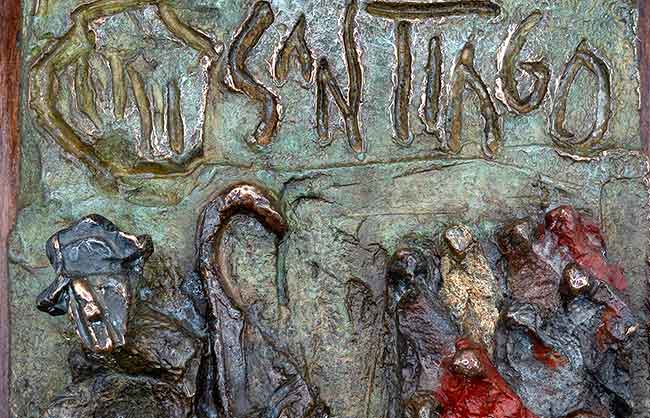
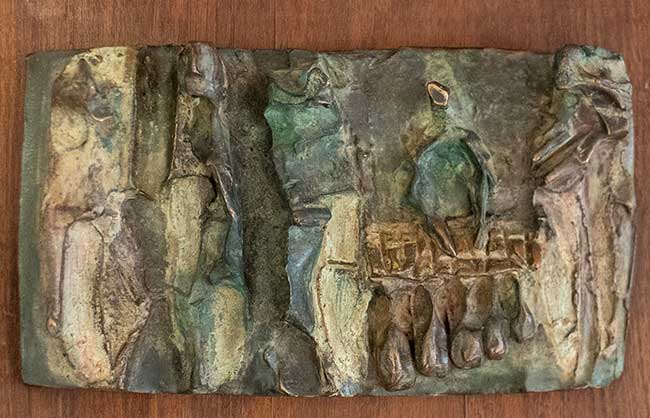
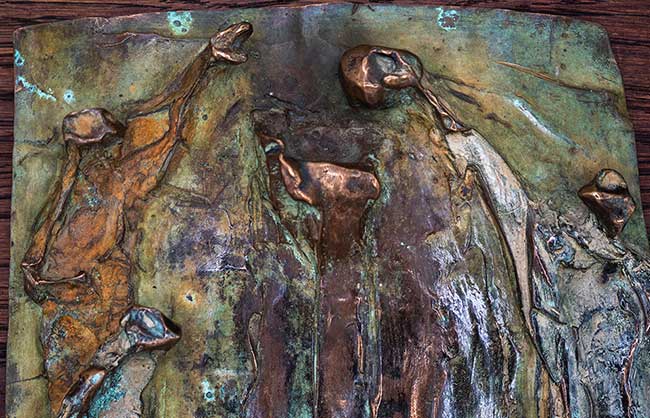
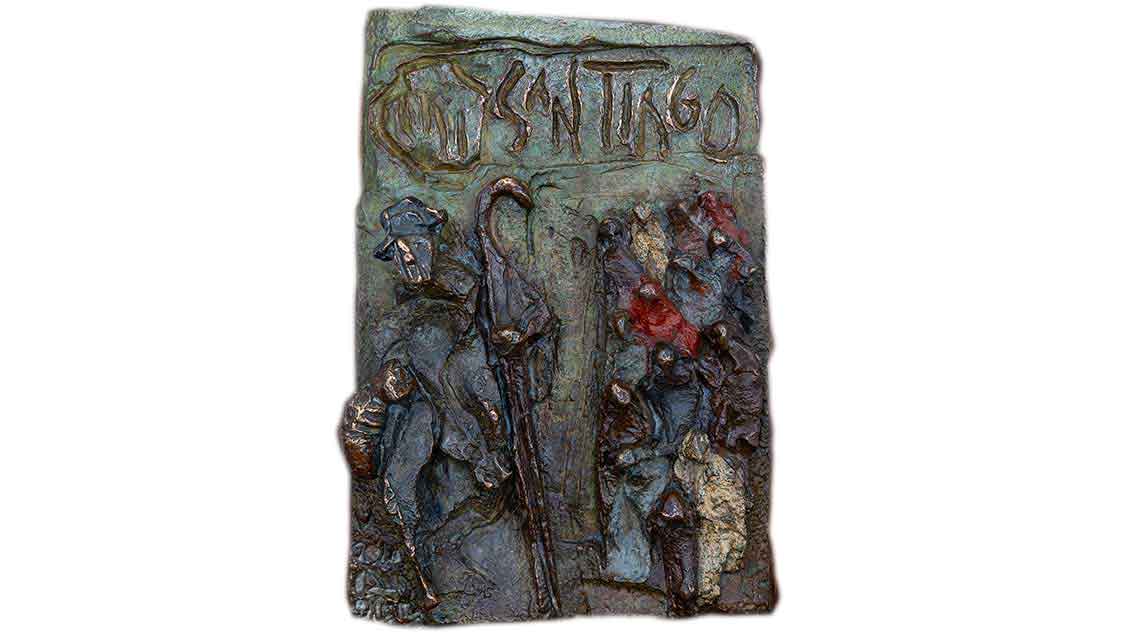
| Characteristics: | Santiago is a vertical bronze relief mounted on a wooden support. The composition is organised around the elongated figure of the apostle, positioned slightly to the left of centre and identified through his pilgrim-like presence and the long staff that runs through much of the work. The figures are arranged in two groups. On the left, several larger travellers appear, while the right side gathers a denser crowd constructed through overlapping heads, bodies and garments. This accumulation creates a compact scene filled with rhythm and multiple directions of movement. The surface retains incisions, rough textures, cavities and varying levels of relief. A rich patina of greens, blues, browns, ochres and reds differentiates the figures and guides the eye across the composition. On the most projecting areas, the warm tone of the bronze re-emerges, adding small points of light. The upper section contains the inscription “SANTIAGO”, integrated into the modelling itself, together with a form associated with the pilgrim’s scallop shell. Word, symbol and figures thus belong to the same sculptural language. |
| Artwork: |
Click to enlarge |
| Description: |
Antonio Oteiza presents Santiago from a perspective far removed from the triumphant or warrior image of the apostle. Here he is not a victor dominating the scene, but a point of reference who accompanies and gives direction. His vertical presence distinguishes him from the other figures, yet his body remains within the same space as the pilgrims. The staff reinforces this role. Beyond identifying the traveller, it introduces a firm line within a densely populated and irregular composition. Extending from the upper area to the base, it acts as a visual axis and as a sign of support, continuity and movement. The saint is portrayed with restraint, without any grand gesture. His face is only lightly defined, and the long garment falls in a narrow volume. Oteiza avoids individual portraiture and instead creates a presence recognisable through posture, attributes and relationship with the group. The pilgrims do not form an ordered procession. Their bodies overlap, shift in scale and emerge from different depths within the relief. Some appear to carry belongings; others seem to pause, observe or wait. This variety prevents a uniform reading and turns the crowd into a sum of personal experiences. Colour plays a decisive role. Greens and blues create a shared atmosphere, while reds, ochres and warm bronze reflections emphasise particular bodies and gestures. The patina does more than cover the surface: it structures the scene, establishes depth and allows some figures to advance visually while others remain more fully integrated into the background. The red accents within the group on the right introduce a particular intensity. They do not operate as mere decoration, but as points of human energy within the mass. The scene gains an emotional vibration that contrasts with Santiago’s calm verticality. The inscription at the top is also part of the sculptural construction. Its irregular letters, modelled with a direct and visible gesture, preserve the energy of the creative process. The name does not simply identify the figure; it crowns the relief and explicitly connects the work with the apostle and the Way of Saint James. The scallop shell contributes to that identification, although Oteiza avoids an overly detailed narrative. A few essential signs are enough — the staff, the shell and the travelling community — to place the viewer within the world of the pilgrimage to Santiago. The composition combines frontality and depth. The figure of Santiago and the inscription establish the primary reading, while changes in relief, cavities and overlapping forms invite closer observation. Each variation of light reveals a face, a hand or a silhouette that had previously remained hidden. Antonio Oteiza’s religious sensibility is expressed here through a communal understanding of pilgrimage. Faith does not appear as a solitary experience or as an immovable certainty, but as a path travelled together. The saint offers direction, yet it is the men and women gathered around him who fill the work with life. Santiago speaks both of the outward journey towards a place of encounter and of a more inward search. In the moving crowd, Oteiza recognises a diverse humanity that shares weariness, hope and the desire for meaning. The true centre of the work is therefore not only the destination, but the experience of walking together. |