Saint Anthony of Padua
| Collection: | Saints in Bronze (Antonio Oteiza) |
| Author: | Fr. Antonio Oteiza |
| Inventory Number: | MCO-AO-RE-00049 |
| Type: | Relief |
| Location: | Cataloguing Room |
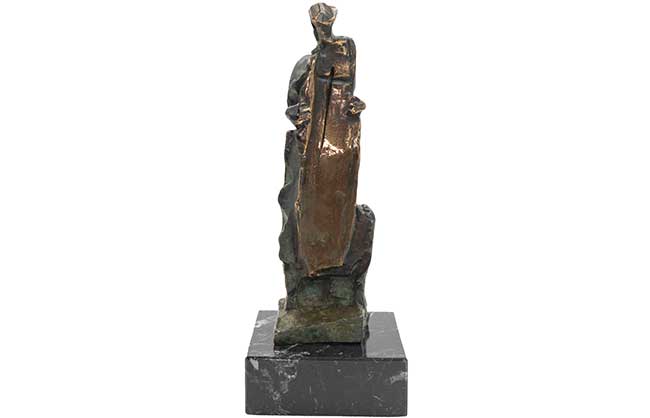
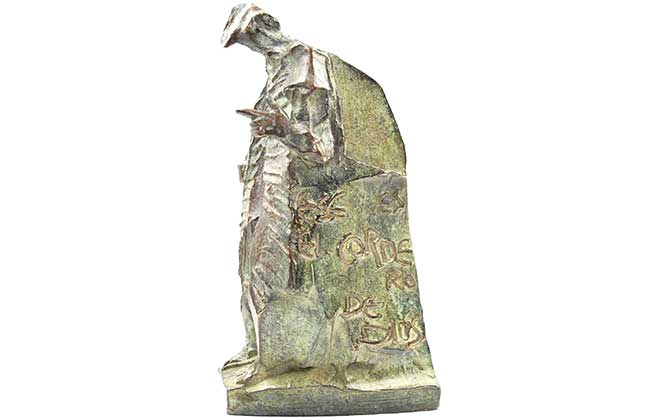
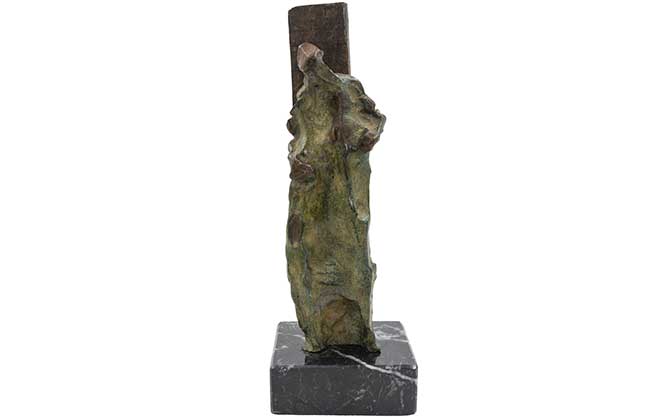
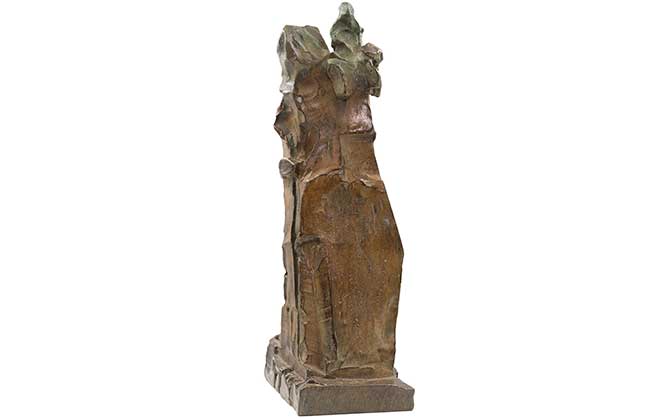
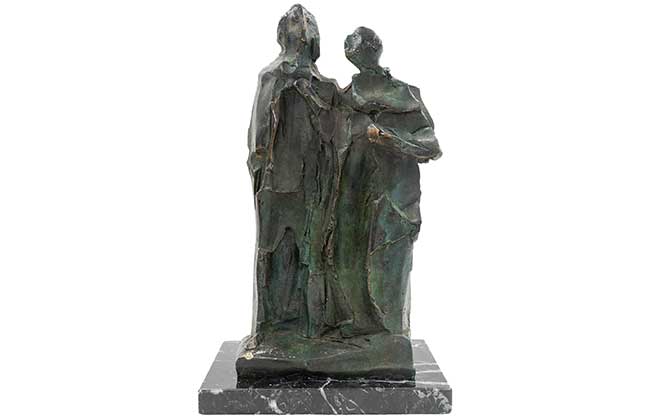
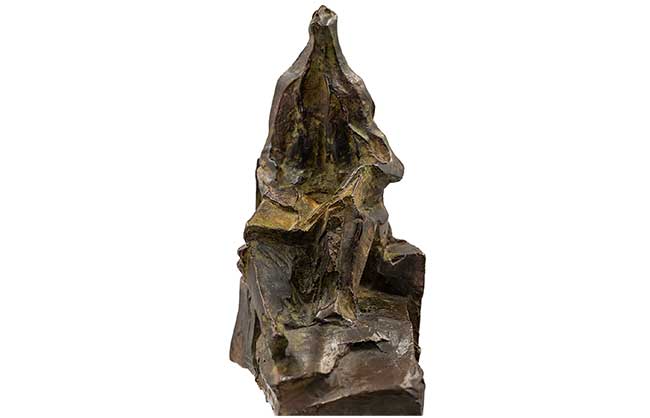
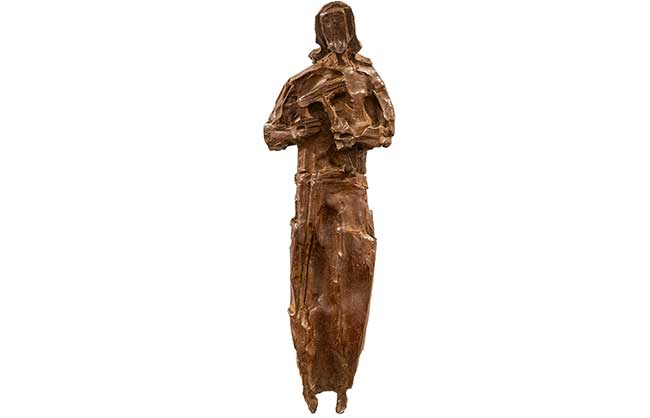
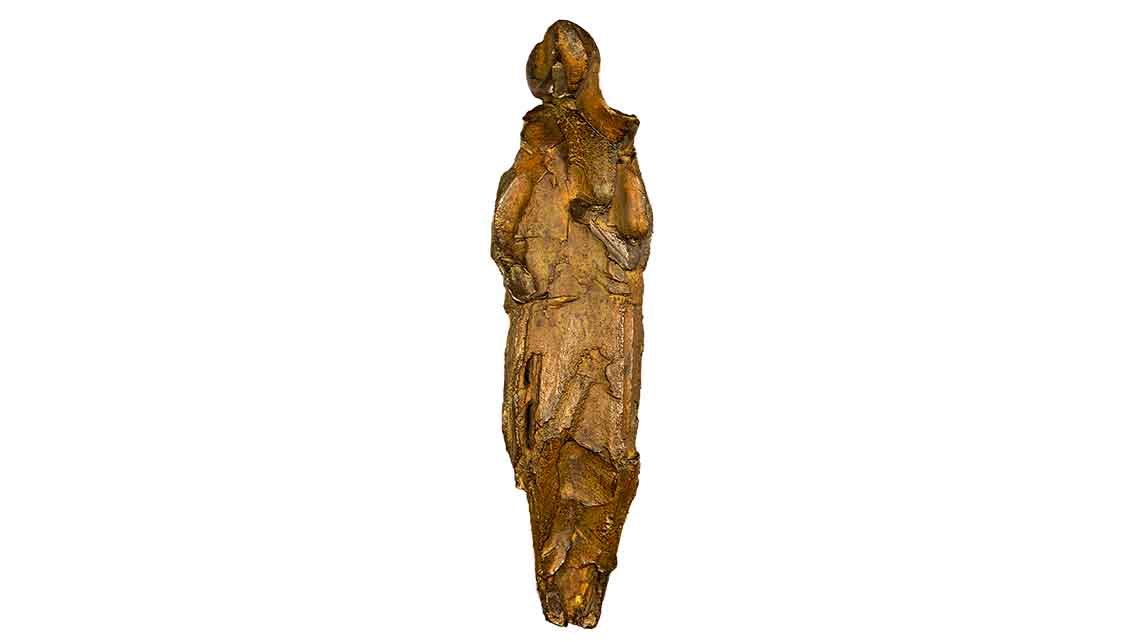
| Characteristics: | Saint Anthony of Padua is a narrow bronze relief with a strongly vertical format. The saint’s silhouette forms the boundary of the work itself, rather than being enclosed within a rectangular plaque. This solution brings the relief close to sculpture in the round and gives particular importance to its outline. The figure is constructed through large irregular planes, overlapping fragments and changes in thickness that replace conventional anatomical description. The slightly inclined head is held within a broad, enveloping form, while the arms converge towards the centre of the body. The Franciscan habit occupies almost the entire composition. Its folds are not rendered naturalistically, but through fractured surfaces, incisions, rough textures and concentrations of material. The cord at the waist is suggested discreetly and identifies Anthony as a member of the Order of Friars Minor. The patina combines ochres, browns, golden earth tones and coppery reflections. Recessed areas become darker, while edges and projecting volumes receive a warmer light. This chromatic variety follows the texture of the bronze and strengthens the relief’s sense of depth. |
| Artwork: |
Click to enlarge |
| Description: |
Antonio Oteiza avoids an overloaded iconography. He does not surround the saint with numerous symbols, nor does he depict a particular episode from his life. Instead, he reduces the image to an essential presence: a man in the Franciscan habit, gathered into himself and entirely focused on what he holds close to his chest. The composition is organised from the centre outwards. The arms fold towards the torso, creating a protected, almost interior space where the work’s spiritual tension is concentrated. The gesture is neither expansive nor spectacular. Its strength lies precisely in the restraint with which it is conceived. The small figure of the Christ Child is integrated into the material of the habit and into the movement of the arms. It is neither presented as an independent attribute nor displayed before the viewer. Oteiza incorporates it into the saint’s body, turning the relationship between them into a single sculptural unit. Anthony does not hold the Child at a distance; he receives him within his own space. This approach transforms one of the best-known motifs in the iconography of Saint Anthony. Rather than emphasising sweet facial expressions or an exchange of glances, the sculptor conveys intimacy through the closeness of the volumes. Affection is not narrated; it is contained within the form. The inclined head continues this movement of inwardness. The face is only sparsely modelled and lacks individualised features. Oteiza sets portraiture aside in order to focus attention on attitude. Saint Anthony is recognised through the habit, the cord, the posture and the relationship with the Child, rather than through physical likeness. The broad volume of the habit absorbs much of the anatomy. The body becomes a continuous form that descends and gradually narrows towards the lower section. This construction gives the figure a quiet stability while also strengthening its upward movement. The surface plays a decisive role. Cracks, roughness, incisions and shifts of plane prevent the work from becoming merely pleasing. The tenderness of the scene does not emerge from smooth material, but from a rough and tension-filled bronze. Oteiza thus places religious experience within a human reality marked by vulnerability. The warm patina deepens this interpretation. Ochres and golden tones envelop the figure, while darker browns gather in the recesses and separations. Small reflections of light appear on the hands, face and edges of the habit, as though brightness were emerging from within the dense material itself. Saint Anthony of Padua was one of the most influential figures of the early Franciscan movement. His life brought together intellectual depth, intense preaching and constant attention to the concrete needs of others. Tradition remembers him as a preacher, a defender of the poor and a man of profound contemplation. Antonio Oteiza condenses these dimensions without turning the work into a biography. The figure neither preaches nor performs a miracle. He simply remains present. In that stillness, contemplation of Christ and readiness to serve others become inseparable aspects of Franciscan spirituality. The absence of other familiar attributes, such as the lily, the book or the bread, concentrates the interpretation. Oteiza removes what is secondary and places the relationship with the Child at the centre of the work. The gesture may also be understood as an image of welcome: holding with care what is small, vulnerable and in need of protection. Saint Anthony of Padua offers a profoundly restrained vision of the saint. He is not presented as an inaccessible figure, but as someone whose strength arises from closeness. Through the union of bodies, material and silence, Oteiza expresses a religious sensibility in which contemplation of Christ necessarily leads to recognising, caring for and serving others. |