Drums of Bajo Aragón
| Collection: | Music in Bronze (Antonio Oteiza) |
| Author: | Fr. Antonio Oteiza |
| Inventory Number: | MCO-AO-RE-00006 |
| Type: | Relief |
| Location: | Cataloguing Room |
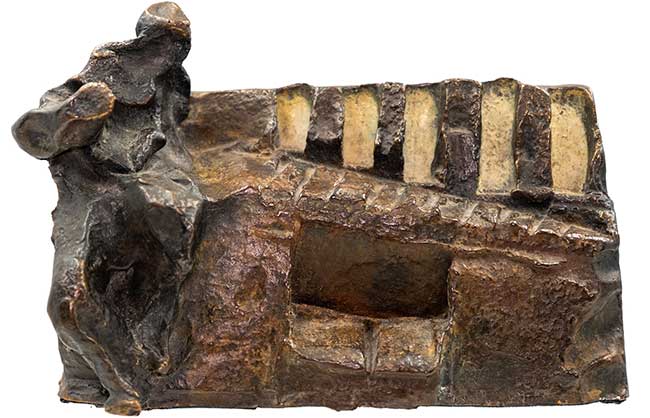
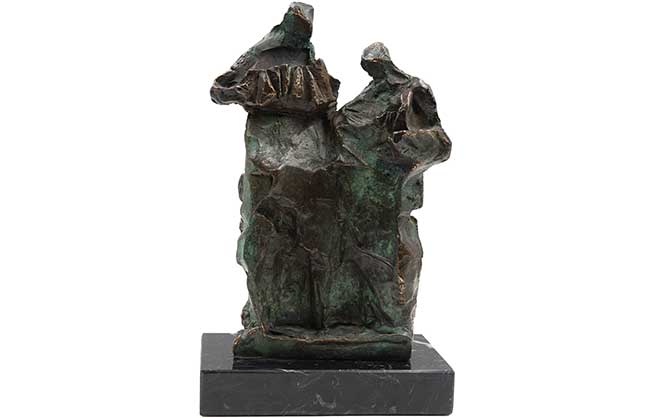
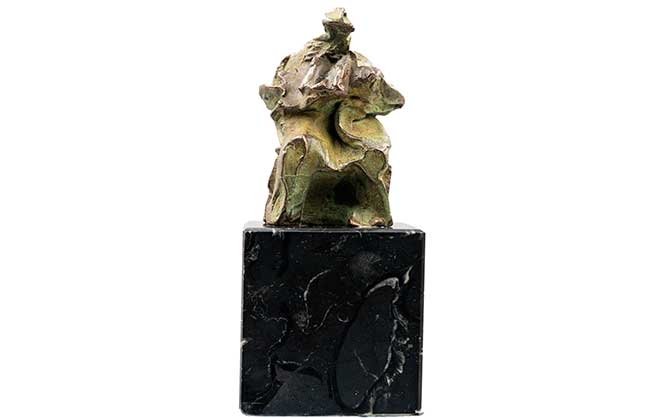
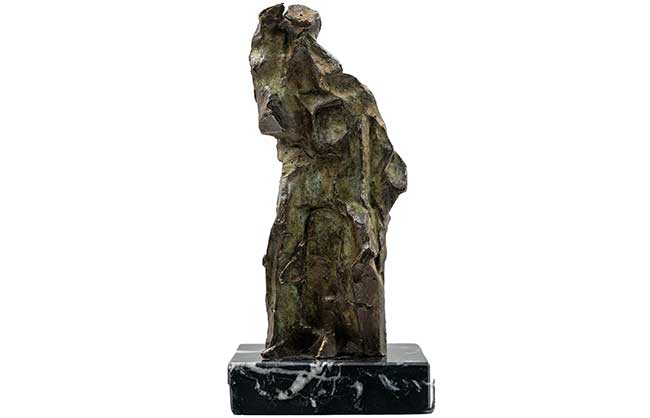
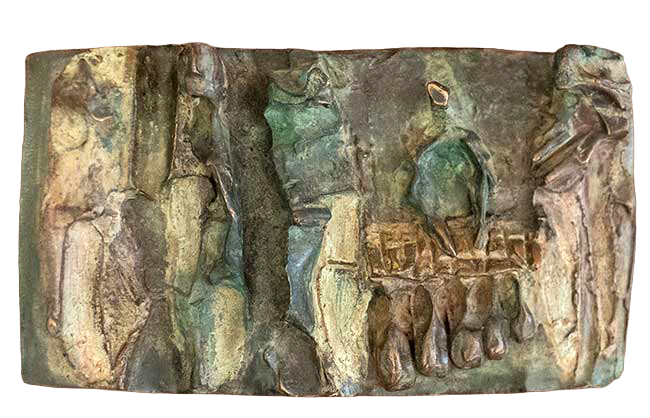
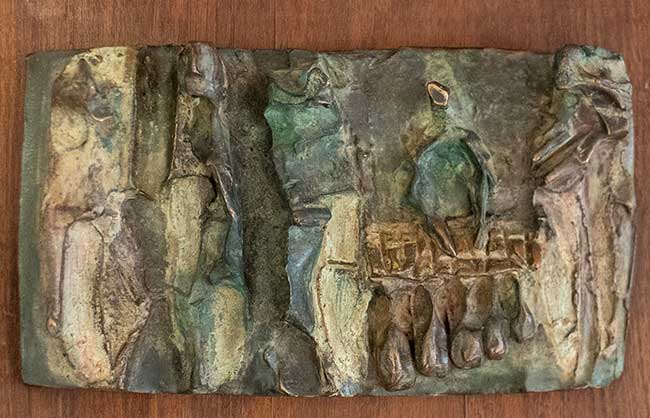
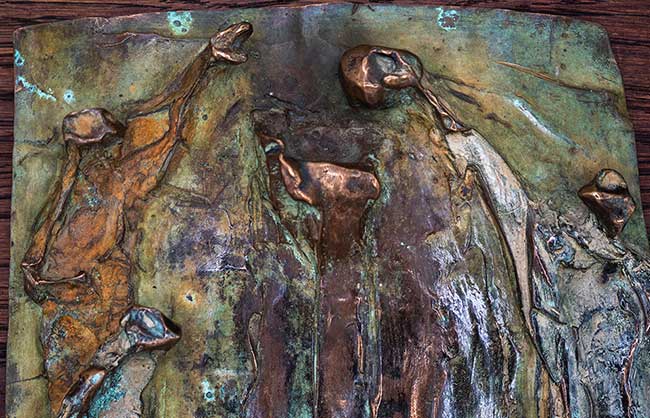
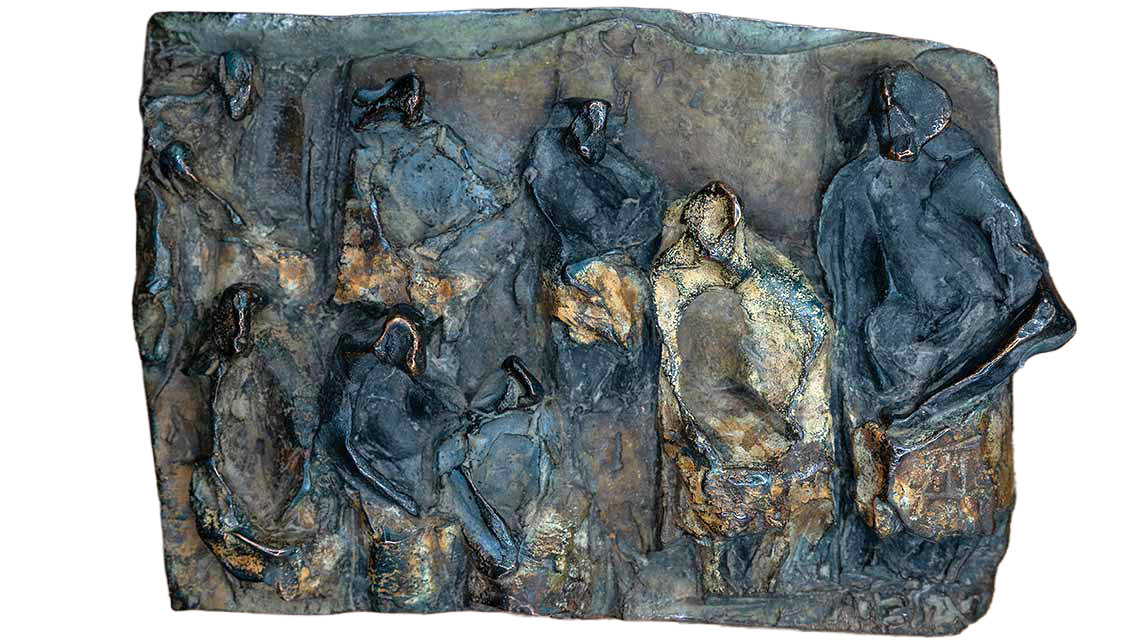
| Characteristics: | Tambores del Bajo Aragón is an autonomous bronze relief in a horizontal format with a slightly irregular outline. The composition brings together numerous performers arranged at different levels of depth, from figures that remain closely attached to the background to volumes that project forcefully towards the viewer. The bodies are constructed through fragmented planes, concavities, folds and compact masses. The faces have no individualised features, while drums, bass drums, arms and drumsticks organise the scene through a succession of circular, vertical and diagonal forms. The patina combines bluish greens, greys, blacks and dark earth tones with ochre, golden and coppery highlights. Certain figures and instrumental elements acquire greater luminosity, allowing the deliberately complex composition to be visually ordered without establishing a single protagonist. The surface preserves incisions, roughness, small cavities and accumulations of material that fragment the light. The bronze therefore acquires a vibrating and changing quality, especially noticeable along the edges of the instruments, the hands, the faces and the drumsticks. |
| Artwork: |
Click to enlarge |
| Description: |
The traditions of drums and bass drums constitute one of the most powerful collective expressions of Bajo Aragón. Sound spreads through streets and squares, travels physically through air and ground, and transforms individual participation into a shared experience. Antonio Oteiza does not depict a specific town or reconstruct a particular procession in documentary terms. Nor does he present the musicians as isolated characters. His attention is directed towards the crowd and towards the way rhythm gathers bodies within a single action. The composition is organised as a continuous human mass. Figures overlap, partially conceal one another and occupy almost the entire available field. Some stand upright; others lean over their instruments or become absorbed among drums, arms and folds of clothing. This concentration conveys the intensity of a celebration in which individual space yields to the force of the group. Oteiza avoids establishing a single centre. Although certain figures stand out because of their size, position or lighter patina, the eye does not remain fixed on any one of them. It moves from one character to another, following an open and choral structure. The instruments play a decisive role. Their circular and semicircular forms are repeated at different heights and depths, creating a visual cadence that runs across the entire relief. Each drum acts as a point of resonance, but it is their repetition that turns the scene into a true architecture of rhythm. The drumsticks introduce diagonal lines that cut through the stability of the bodies. Some appear raised; others approach the striking surfaces. Their varied positions bring together different moments of the beat within a single image and allow the viewer to imagine a continuous sequence of sound. The artist does not seek to describe the technique of each performer with precision. Hands and arms are reduced to the essential components of the gesture. What matters is not the reconstruction of every movement, but the repeated energy that passes through the crowd. The faces are only suggested. They appear as oval or angular forms marked by deep shadows and occasional metallic highlights. By renouncing portraiture, Oteiza shifts attention from individual identity to belonging within the group. This simplification does not remove the humanity of the figures. On the contrary, it allows them to be understood as members of an experience that unites and surpasses them. Each musician retains a distinct presence, yet all are integrated into the same sonic event. The background does not represent recognisable architecture. Its vertical divisions and changes of level create enough spatial structure to organise the figures, without distracting the eye through specific references to place. The scene could continue beyond the limits of the bronze. The horizontal format reinforces this sense of continuity. The action unfolds as a broad sequence rather than being enclosed around a central figure. Even the irregularity of the perimeter contributes to the impression that the relief is a fragment taken from a much larger human gathering. The lighter figure towards the right introduces a pause within the chromatic density. Its presence helps organise the visual journey and establishes an interval between the dark volumes at the far right and the accumulation of performers across the left half. The patina performs a structural function. Bluish greens and greys unify the ensemble and create a grave atmosphere, while ochres, coppers and golden tones indicate instruments, faces, hands and edges. Light activates these contrasts and causes the scene to change according to the viewer’s position. The rough surface intensifies the perception of sound. Incisions, projections, cavities and accumulations prevent light from remaining still. A succession of flashes and shadows unfolds across the bronze, recalling the irregular, insistent and enveloping vibration of percussion. Oteiza distances himself from any picturesque interpretation of tradition. He does not describe costumes, buildings or ceremonial details. He reduces the scene to its essential components: gathered bodies, repeated instruments, arms in action and a space crossed by rhythm. The work also possesses a deeply physical dimension. The sound of drums and bass drums is not only heard; it is felt in the body. Oteiza translates that experience through compact volumes, strong projections and a material density that seems to respond to the force of the strikes. The relief refers to a specific tradition, yet reaches a broader meaning. It evokes shared memory, ritual, synchrony and the ability of a community to recognise itself through an action performed together. In Tambores del Bajo Aragón, the leading role belongs not to any one musician, but to the rhythm circulating among them all. Antonio Oteiza allows the bronze to remain silent while preserving the impression of a collective thunder that seems to continue beyond the limits of the work. |