Accordion Player
| Collection: | Music in Bronze (Antonio Oteiza) |
| Author: | Fr. Antonio Oteiza |
| Inventory Number: | MCO-AO-ES-00051 |
| Type: | Sculpture |
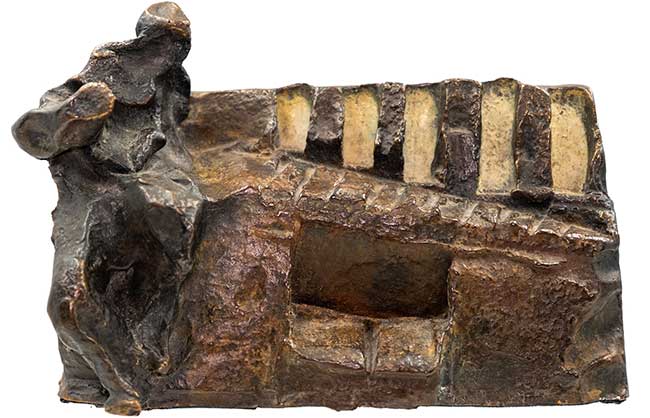
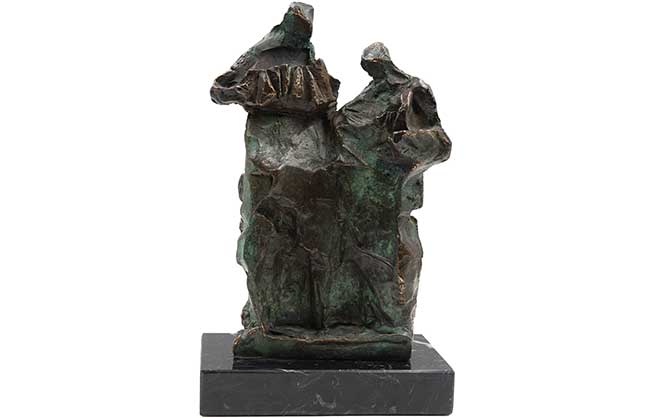
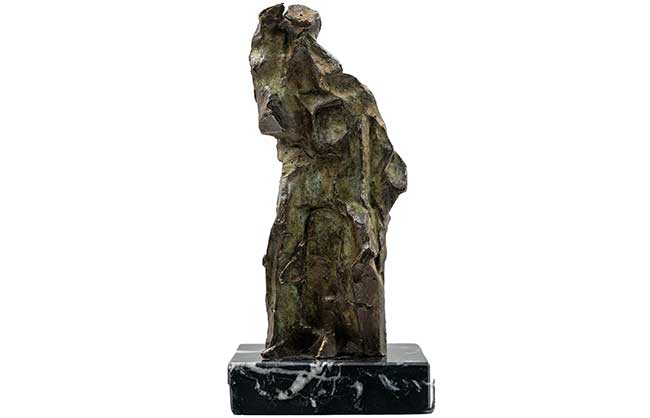
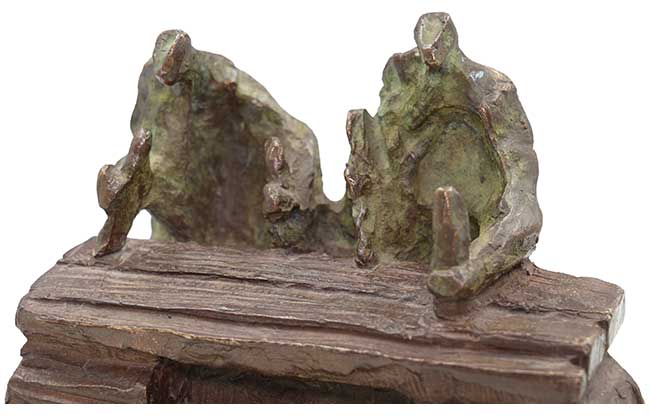
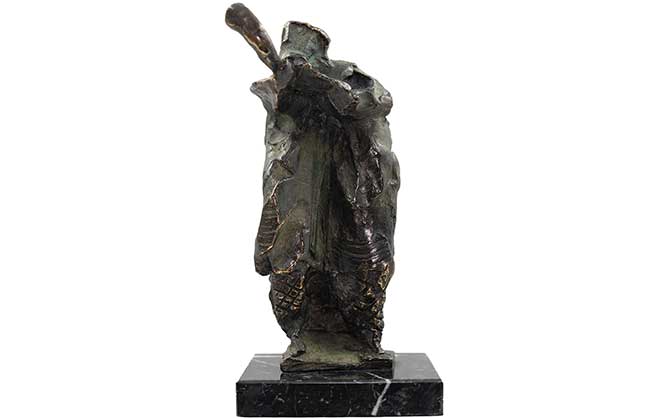
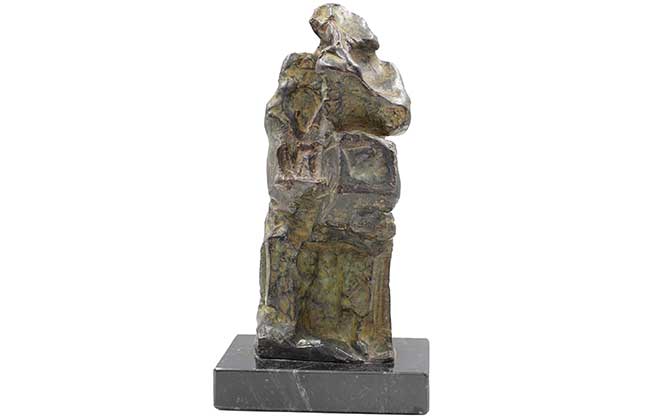
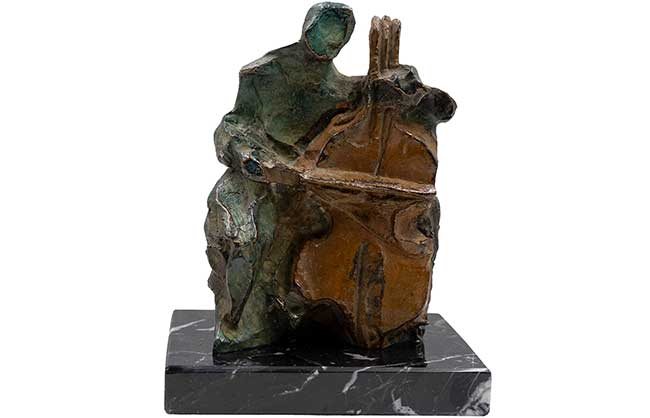
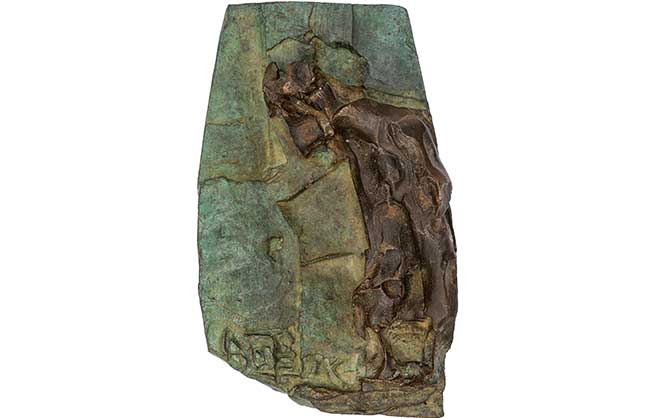
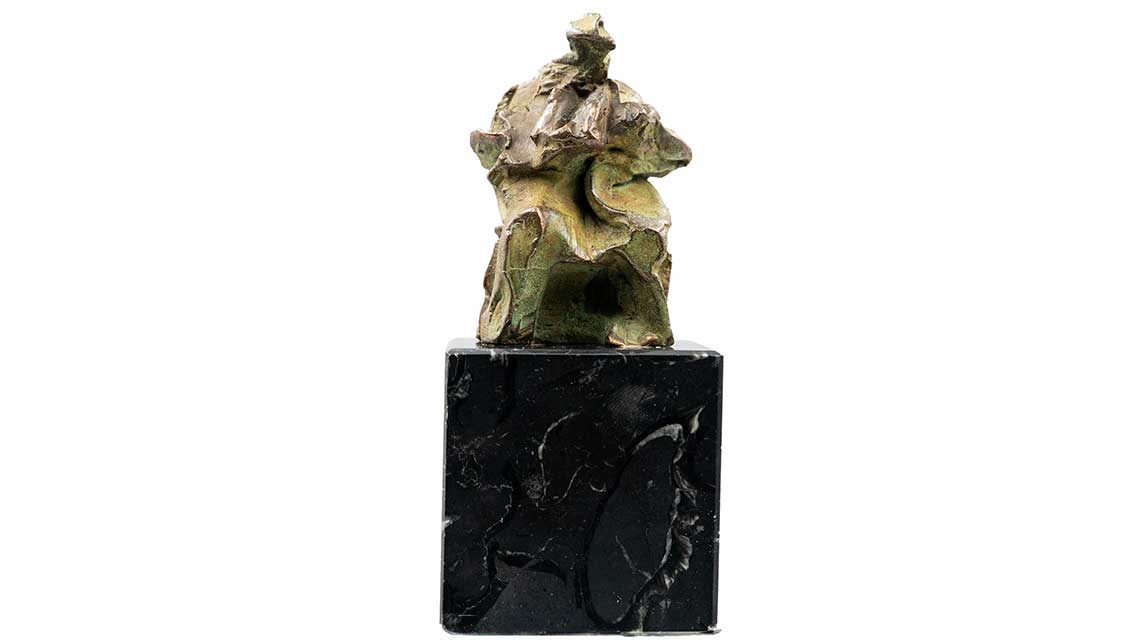
| Characteristics: | Accordion Player is a freestanding bronze sculpture depicting a seated figure holding the instrument against the chest. Body, accordion and seat are integrated into a compact structure defined by irregular contours and a strong concentration of volume. The anatomy is reduced to broad planes, curved forms, cavities and changes in thickness. The face has no individualised features, while the hands merge visually with the instrument. The act of playing is therefore conveyed less through detailed description than through posture and the organisation of the body. The patina combines greens, ochres and browns with coppery highlights. Lighter tones spread across the broader surfaces, while the recesses and junctions between volumes retain greater depth and darkness. Along the edges and projecting areas, the warmer colour of the metal reappears. The sculpture stands on a tall, prism-shaped plinth of polished black marble. The geometric solidity of the block and its natural veining create a powerful contrast with the organic, fragmented and shifting surface of the bronze. |
| Artwork: |
Click to enlarge |
| Description: |
In Accordion Player, Antonio Oteiza does more than depict a person playing an instrument. He establishes such an intimate relationship between musician and accordion that it becomes difficult to determine where the body ends and the instrument begins. Music appears as an action that engages the performer completely. The figure is seated, yet conveys no sense of rest. The torso turns slightly, the arms close around the instrument and the head rises from a posture of intense concentration. The apparent stillness of the bronze contains continuous tension, comparable to that required to open and close the bellows, coordinate both hands and sustain the rhythm. The accordion forms the physical and expressive centre of the sculpture. Oteiza does not reproduce its keys, buttons or mechanisms with technical precision. He identifies the instrument through articulated planes, folds and volumes that evoke its structure without turning the sculpture into a descriptive study. His attention is directed towards the act of playing and towards the bond that this gesture creates between person and object. The arms form an enclosure around the accordion. The hands barely separate from the material that shapes the instrument and seem to emerge from it. This continuity removes any distance between performer and music: the accordion is not an added attribute, but the core around which the entire body is organised. The face also avoids individualisation. The angular head, turned slightly to one side, offers no fixed expression. Oteiza shifts attention away from physiognomy and towards attitude. What matters is not the identity of a particular person, but the state of commitment and listening that accompanies performance. The sculpture changes noticeably when viewed from different angles. From the front, the relationship between arms and instrument draws the eye. The side views reveal the turn of the torso, the separation of the legs and the stepped construction of the seat. From behind, the figure becomes a broad, compact mass, and the musical narrative gives way to a more abstract reading of volume. The cavities are as important as the solid forms. Deep spaces open beneath the arms, between the accordion and the torso, around the legs and within the structure of the seat. These shadowed areas lighten the mass and allow the composition to breathe without diminishing its density. The surface preserves the directness of the modelling. Incisions, irregularities, abrupt transitions and accumulations of material break up the light. The bronze does not behave like a uniform skin, but like a changing terrain that seems to respond to the movement of the musician. The patina contributes decisively to this impression. Greens and ochres move across the broader surfaces and give the sculpture an almost mineral appearance, while coppery reflections gather on the head, arms, hands and edges. As the viewer moves around the work, light continually reconstructs the gesture. The plinth introduces a second scale. Its volume is considerable in relation to the small bronze and raises the figure to an almost monumental presence. The polished, geometric black marble acts as a silent architecture upon which the sculpture unfolds its organic complexity. This contrast also alters the perception of the work. The regularity of the block emphasises the asymmetry of the bronze, while the stillness of the stone makes the tension contained in the figure more evident. The support is therefore not neutral, but actively contributes to the final image of the ensemble. Music is an especially demanding subject for sculpture because it has no visible form and disappears at the very moment it is produced. Oteiza confronts that difficulty without attempting to materialise sound literally. He makes it imaginable through the body: through torsion, pressure, posture and the concentration of volumes. Accordion Player turns an everyday scene into a reflection on creation. The music cannot yet be heard, but it seems already to occupy the interior of the sculpture. Through the union of performer, instrument and material, Antonio Oteiza preserves in bronze the tension of a sound on the verge of emerging. |