Cellist
| Collection: | Music in Bronze (Antonio Oteiza) |
| Author: | Fr. Antonio Oteiza |
| Inventory Number: | MCO-AO-ES-00057 |
| Type: | Sculpture |
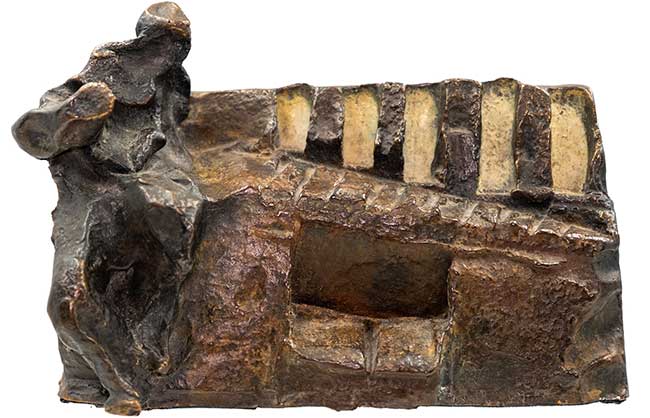
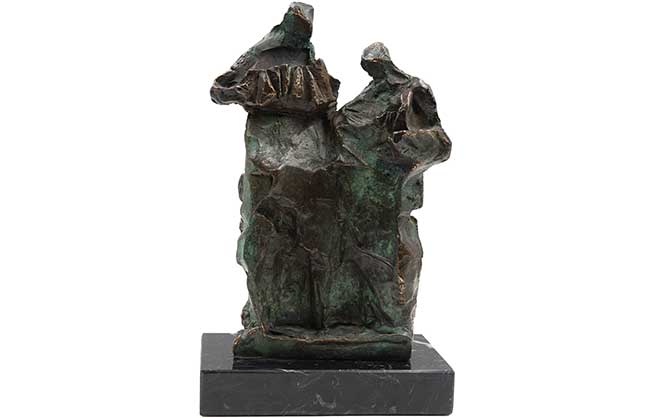
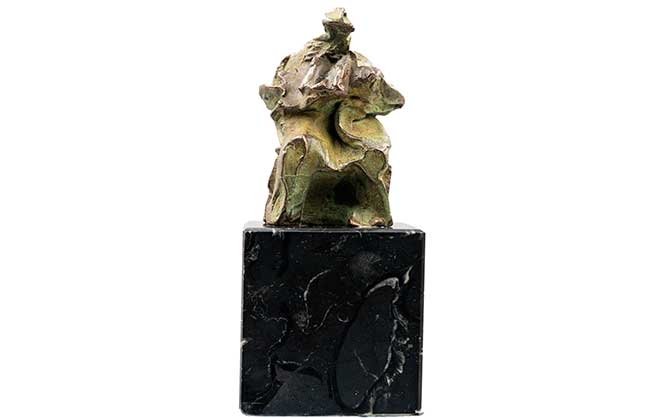
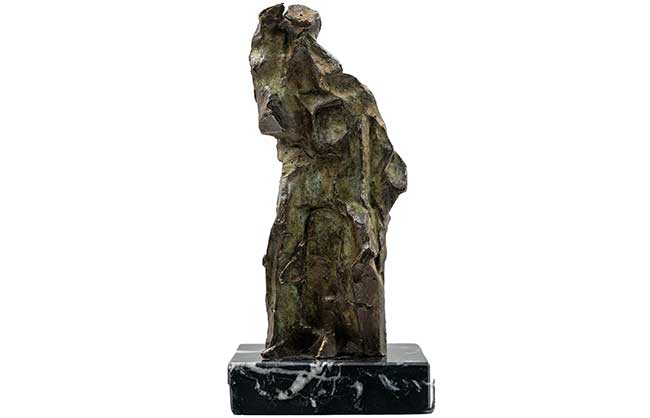
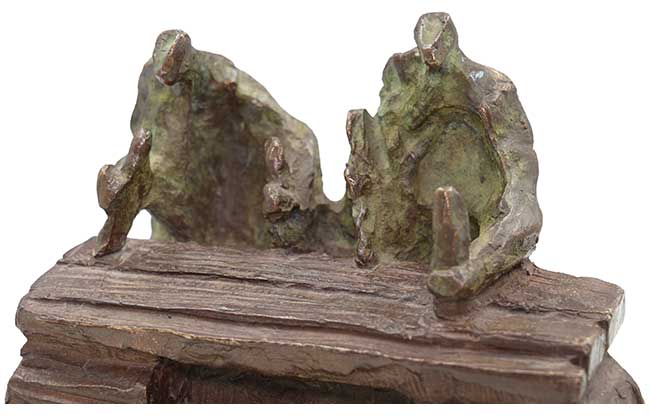
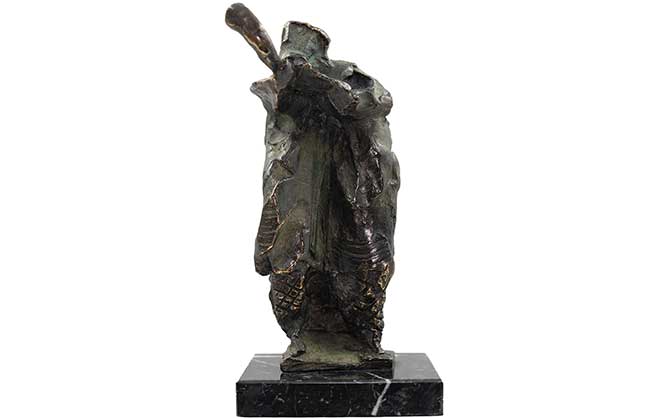
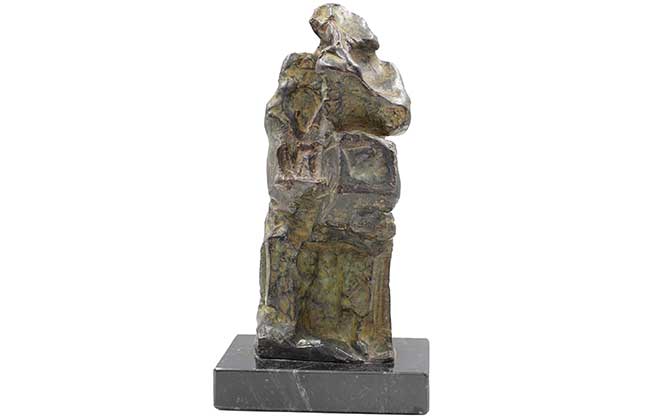
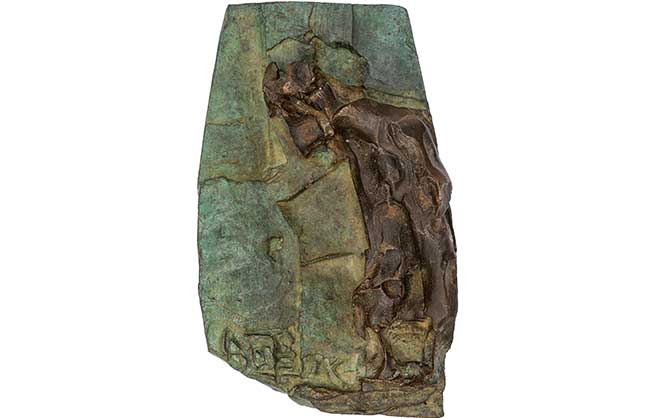
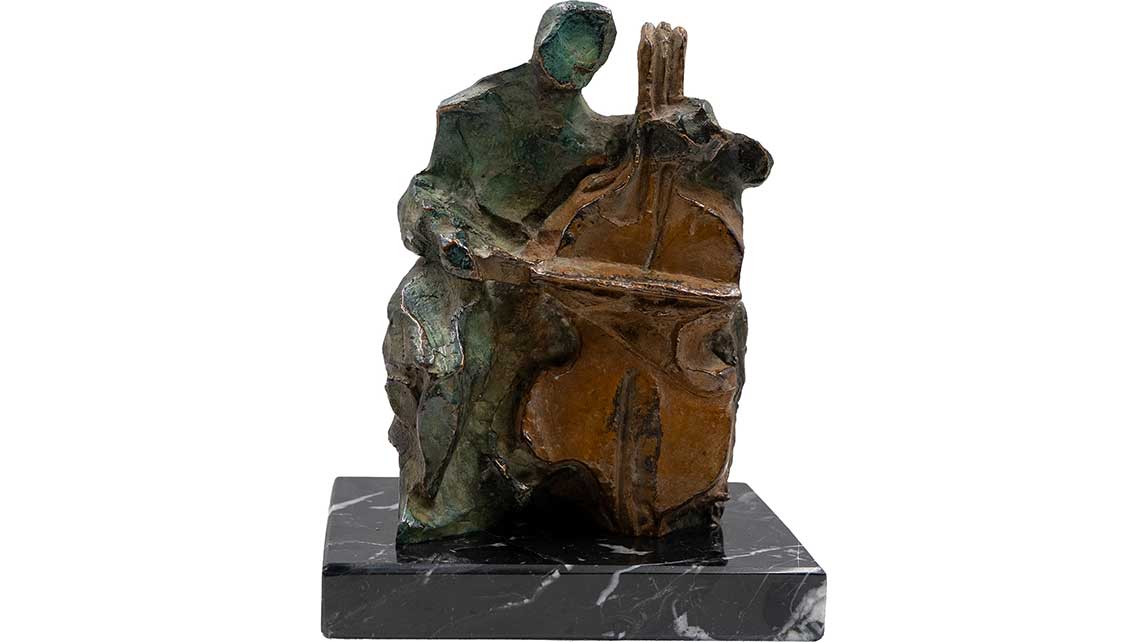
| Characteristics: | Cellist is a freestanding bronze sculpture depicting a seated musician with the instrument positioned vertically in front of the body. The composition is compact and highly concentrated in volume: performer, cello and seat are integrated into a single block, structured by the contrast between the instrument’s verticality and the horizontal movement of the bow. The figure is constructed through broad planes, concavities, irregular edges and changes in thickness. The face has no individualised features, and expression is concentrated in the inclination of the head, the position of the arms and the physical relationship established between the musician and the cello. The patina subtly distinguishes the two bodies. Dark greens, browns and greyish tones predominate on the performer, while the instrument takes on warmer nuances of ochre, reddish brown and golden bronze. Metallic highlights appear on the hands, the bow, the edges and the most exposed areas. The work rests on a rectangular plinth of polished black marble. The regularity of the support contrasts with the rough, organic surface of the bronze and reinforces the concentrated presence of the ensemble. |
| Artwork: |
Click to enlarge |
| Description: |
Antonio Oteiza finds in the figure of the musician one of his most fertile artistic territories. His interest lies not only in depicting a recognisable instrument, but also in examining how performance transforms the body, compelling it to bend, concentrate and reorganise itself around sound. In Cellist, this relationship reaches a particular intensity. The cello is not held at a distance and does not function as an added object. It stands between the performer’s legs, rests against the body and shares the same vertical axis. The musician appears to embrace it, while at the same time allowing its presence to shape the entire posture. The body of the instrument occupies the visual centre of the sculpture. Its warm, curved volume advances towards the viewer, while the cellist’s body remains partially withdrawn behind it. Oteiza thus turns the cello into far more than an iconographic attribute: it becomes the true centre of gravity of the work. The head inclines towards the instrument and is reduced to a concave, almost anonymous form. There is neither portraiture nor detailed facial expression. The attitude of listening is conveyed far more profoundly through posture: the face seems to withdraw so that all attention may rest on vibration and musical gesture. The arms converge over the cello. One hand is placed on the upper section of the neck, while the other is connected to the bow, which crosses the composition horizontally. This line is essential because it interrupts the vertical stability of the ensemble and introduces a temporal direction, as though preserving the movement from which sound is born. The cello contributes weight, rootedness and resonance. The bow, by contrast, introduces passage, impulse and continuity. The sculpture is built upon the dialogue between them: one remains still and receives vibration; the other moves across the strings and sets the music in motion. Oteiza avoids a meticulous description of playing technique. The hands do not reproduce exact fingering, and the instrument is not rendered with organological precision. The sculptor retains only what is necessary to express the physical truth of performance: pressure, inclination, balance and contact. This synthesis does not impoverish the scene; it intensifies it. By removing secondary detail, the artist concentrates attention on the relationship between musician and instrument. Each volume responds to the other, and the entire composition appears to be governed by the same inner necessity. The body is partially concealed by the cello. The legs, seat and torso merge into a compact mass that supports the instrument and at the same time seems to extend it. Anatomy ceases to function as an independent structure and becomes part of the resonating mechanism. The cavities opened between the arms, torso and instrument play a decisive role. In such a dense composition, these voids allow the form to breathe, gather shadow and distinguish the different gestures without breaking the unity of the whole. The surface also contributes to the character of the performance. Incisions, casting ridges, depressions and accumulations of material resist any uniform reading. The bronze preserves the immediacy of the modelling and appears to respond to the pressure of the hands, the weight of the body and the movement of the bow. The patina deepens this relationship. Warmer tones bring the cello visually forward and emphasise its role as the source of sound. The greens and browns of the musician place the figure further back, as though the performer were withdrawing behind the instrument in order to listen more closely to what is being produced. The work changes when viewed from different angles. From the front, the cello dominates the scene and the bow introduces the principal movement. From the sides, the way the body curves around the instrument becomes more evident. From the rear, the musical narrative almost disappears and the performer’s back becomes a broad, closed and protective surface. This difference between front and back is essential. From the front, the work speaks of performance; from the rear, of the bodily architecture that makes music possible. The viewer discovers that the visible gesture depends on a structure of support, balance and concentration that remains largely hidden. The black marble plinth establishes a stable and silent plane. Against its geometric regularity, the irregular bronze gains strength, and the relationship between body and instrument is perceived as a single organic presence. Oteiza does not present the musician as a spectacular or heroic figure. He shows the performer absorbed, attentive and governed by an inner discipline. Music arises here from listening, repetition and a bodily commitment that requires no exaggeration. Cellist preserves one of those moments in which the performer seems to disappear into the music itself. Bow, instrument and body remain in balance within a silent scene where bronze succeeds in making visible not only the act of playing, but also the profound intimacy of listening. |