Txistulari I
| Collection: | Music in Bronze (Antonio Oteiza) |
| Author: | Fr. Antonio Oteiza |
| Inventory Number: | MCO-AO-ES-00056 |
| Type: | Sculpture |
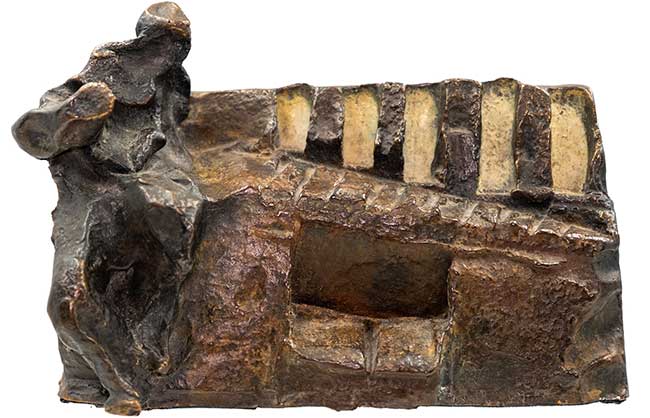
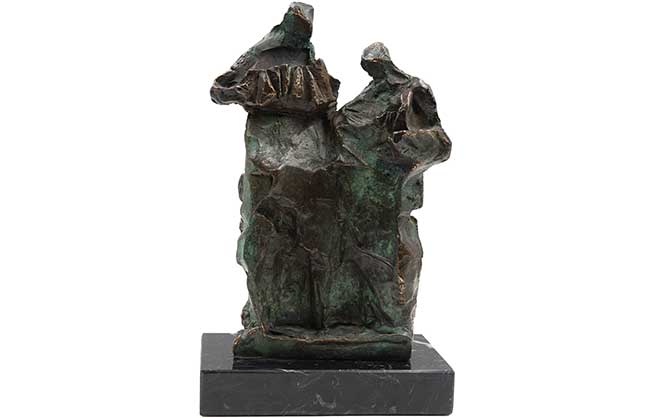
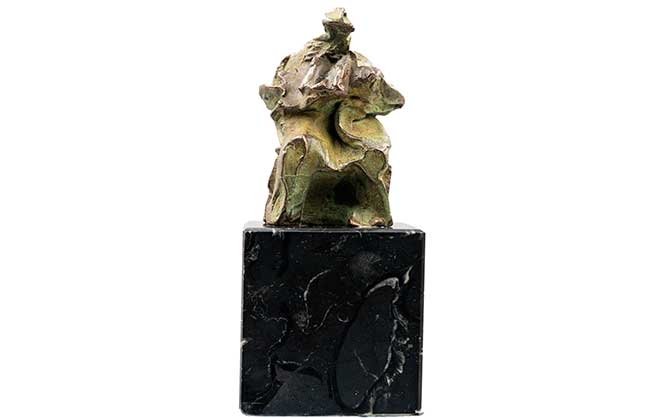
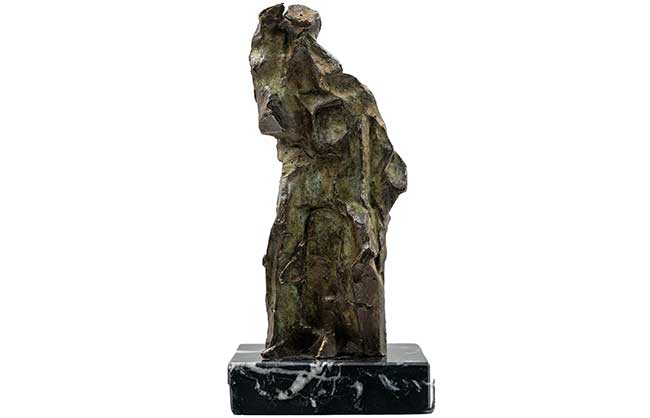
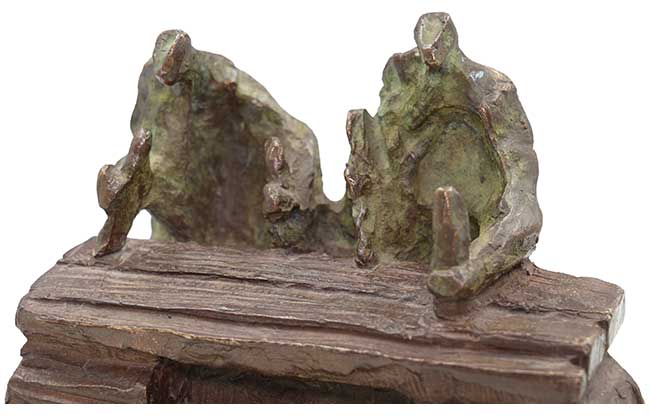
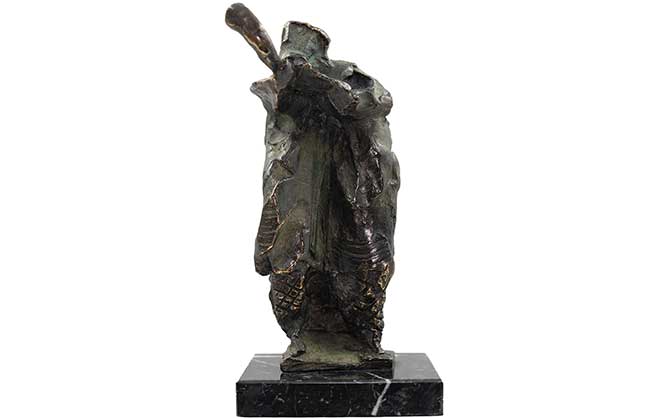
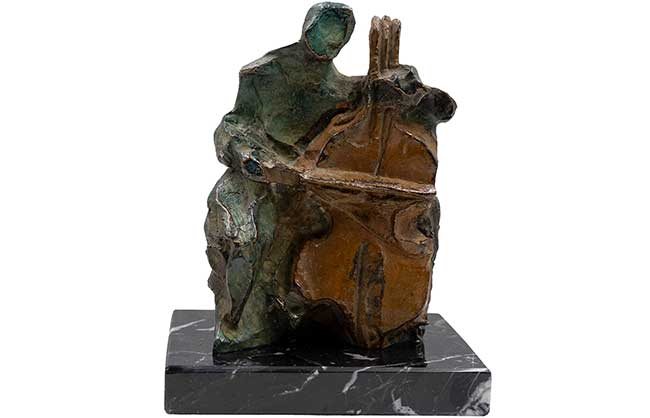
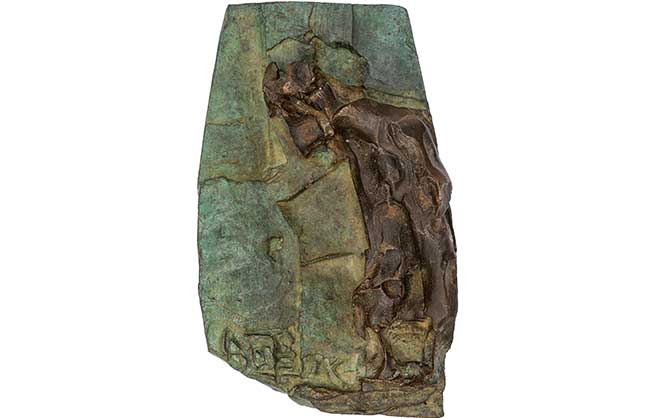
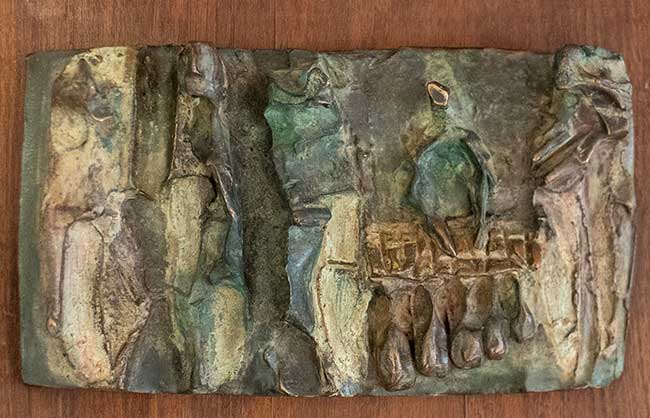
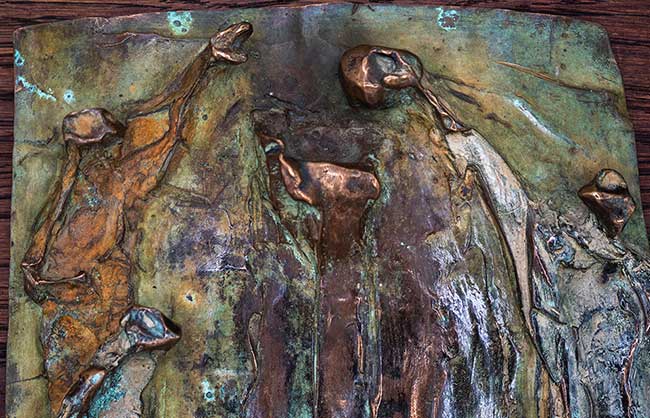
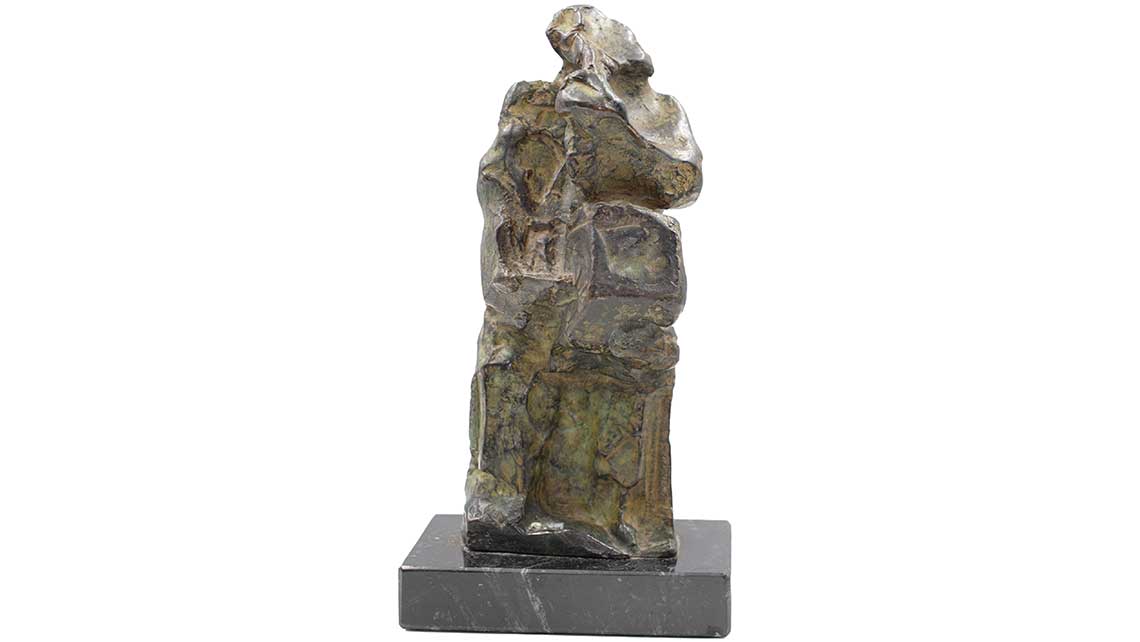
| Characteristics: | Txistulari I is a freestanding bronze sculpture with a vertical, narrow and densely articulated composition. The figure stands upright, holding the txistu close to the face, while a second element associated with percussion occupies the central area of the body and gives weight to the ensemble. The anatomy is constructed through overlapping planes, concavities, edges and volumes of varying thickness. The face has no individualised features, and the hands merge into the instruments, so that performer and musical action are brought together within a single sculptural mass. The patina combines greens, ochres, browns and dark areas with coppery highlights on the most exposed parts. The surface retains visible incisions, grooves, depressions and accumulations of material that break up the light and preserve the direct energy of the modelling process. The work rests on a base integrated into the bronze and on a rectangular plinth of polished dark stone. The regularity of the support reinforces the figure’s verticality and contrasts with the organic complexity of its volumes. |
| Artwork: |
Click to enlarge |
| Description: |
The txistulari occupies a recognisable place within Basque culture. Its music accompanies dances, celebrations, processions and many communal events. Antonio Oteiza, however, does not depict a specific festival or reconstruct a picturesque folk scene. His attention is directed towards the performer and towards the physical demand of making melody and rhythm coexist within a single body. The figure appears upright and deeply concentrated. The txistu rises towards the face and establishes a vertical line connecting breath, hand and head. In front of it, the central volume associated with percussion projects outward and broadens the composition. Oteiza therefore organises the work through two complementary impulses: one raises the sound, while the other gives it measure and weight. The sculptor avoids any detailed description of musical execution. The hands do not reproduce precise fingering, and the instruments are not presented as independent objects. Everything is integrated into a compact structure in which it becomes difficult to separate the body clearly from what it holds and makes sound. This fusion is one of the work’s central features. The musician does not merely carry the instruments; the instruments shape the figure. Posture, the arrangement of the arms and the balance of the masses all respond to the musical act, as though the entire body had adapted itself to the need to breathe, hold, finger and mark the rhythm. The head is reduced to an angular, almost anonymous volume. Oteiza avoids using facial expression as the main source of intensity and shifts that intensity towards the figure’s overall attitude. What matters is not the portrait of a particular individual, but the concentration of someone who has mastered a practice transmitted and repeated over time. The apparent stillness actually contains a complex activity. The body performs no broad movement, yet breath, finger position, listening and percussion must all be coordinated within it. The sculpture transforms this multiplicity of actions into contained tension. The volume placed in front of the torso plays a decisive role. It projects beyond the vertical axis and becomes the composition’s centre of gravity. Its compact planes are balanced by the cavities in the upper section, where arms, instrument and head open areas of shadow that lighten the density of the bronze. These voids are not secondary spaces. They allow the form to breathe and make the relationship between the different elements visible. Around the face and arms, empty space also suggests the invisible realm of air and sound, which sculpture cannot represent literally. The lower section appears more enclosed and stable. The legs merge into a narrow mass that supports the upper volumes. This firmness prevents the concentration of forms in the middle and upper areas from disturbing the overall balance and strengthens the sense of rootedness. The work offers different readings depending on the viewpoint. From the front, the ascending sequence of base, body, instrument and head becomes clear. From the sides, the percussion element gains greater presence and the way the body curves around it is more fully understood. At the rear, the figure loses part of its narrative character and becomes an almost architectural construction dominated by broad vertical planes. The surface is essential to this transformation. Cuts, grooves, reliefs and depressions prevent light from moving evenly across the bronze. Each irregularity activates a different part of the body and causes the figure to recompose itself visually as the viewer moves around it. The patina unifies this formal diversity. Greens and earth tones provide depth and an almost mineral quality, while coppery highlights draw attention to the head, hands, instruments and edges. Colour does not decorate the bronze; it reveals its structure and follows the course of the musical gesture. Antonio Oteiza approaches a tradition deeply connected with Basque identity without turning it into a picturesque image. The txistulari appears as the bearer of a living memory, but also as a universal figure of the performer: someone who transforms breath, technique and listening into a shared experience. Txistulari I preserves the instant in which the musician brings different forces together within a single action. Air becomes melody, the strike establishes rhythm, and the body acts as the meeting point between them. In the silence of bronze, the discipline of music intended for the community remains present. |