Ttuttulari
| Collection: | Music in Bronze (Antonio Oteiza) |
| Author: | Fr. Antonio Oteiza |
| Inventory Number: | MCO-AO-ES-00054 |
| Type: | Sculpture |
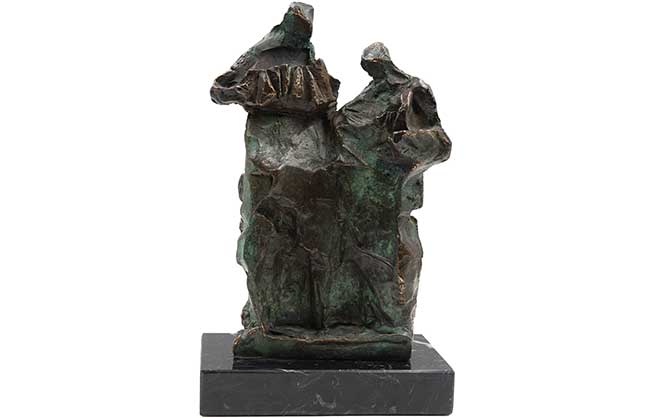
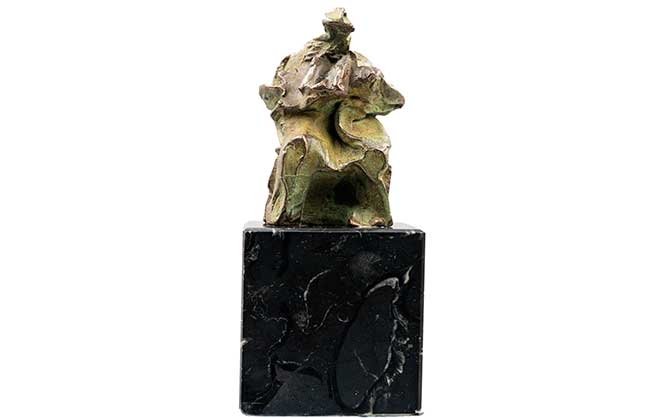
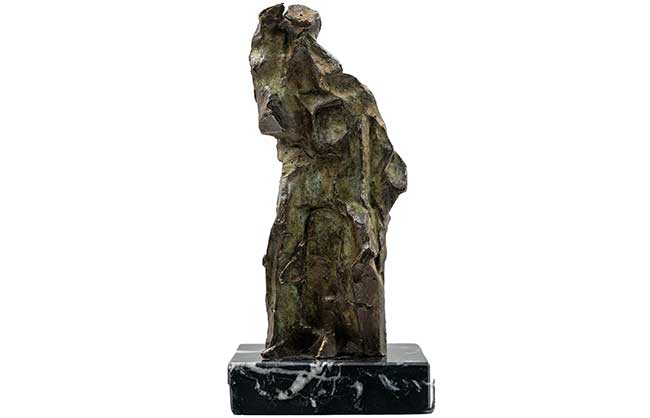
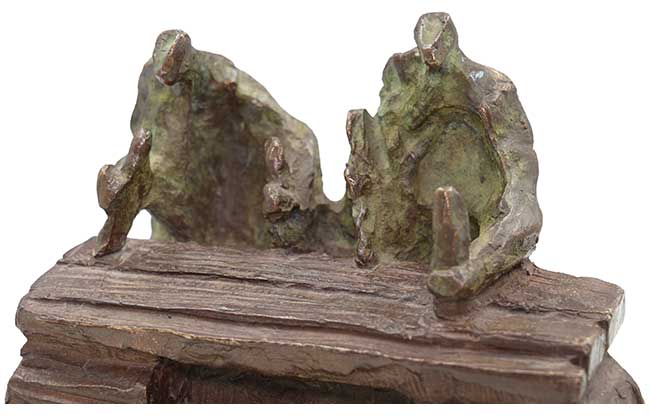
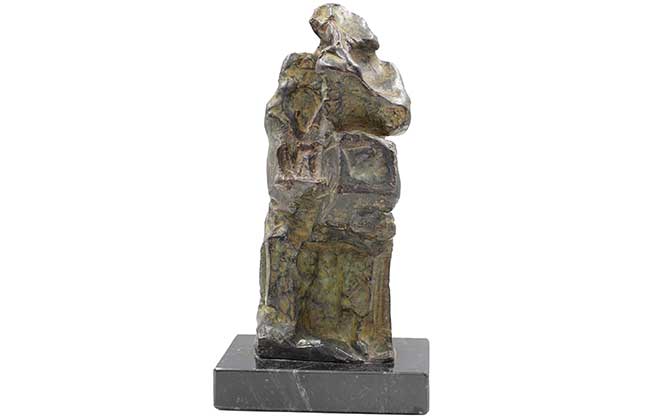
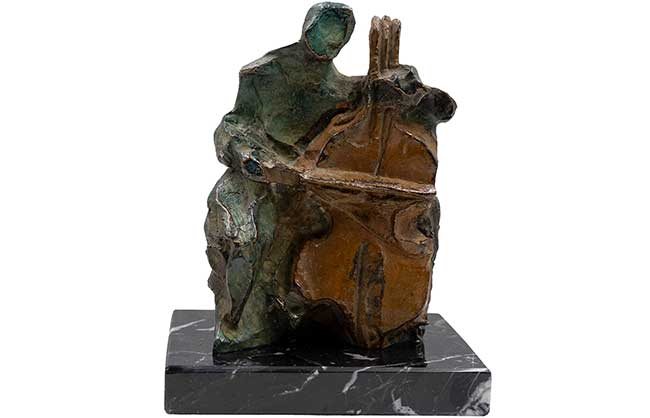
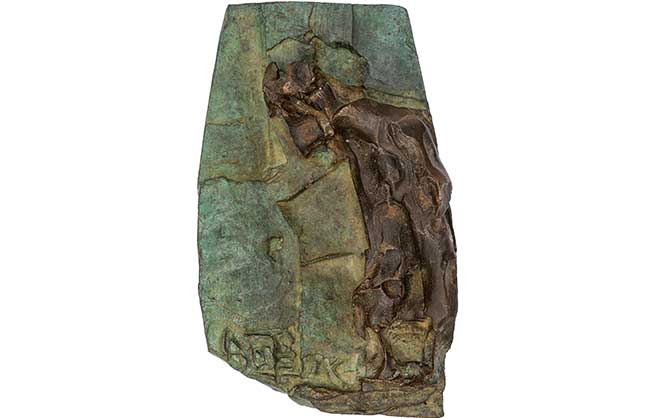
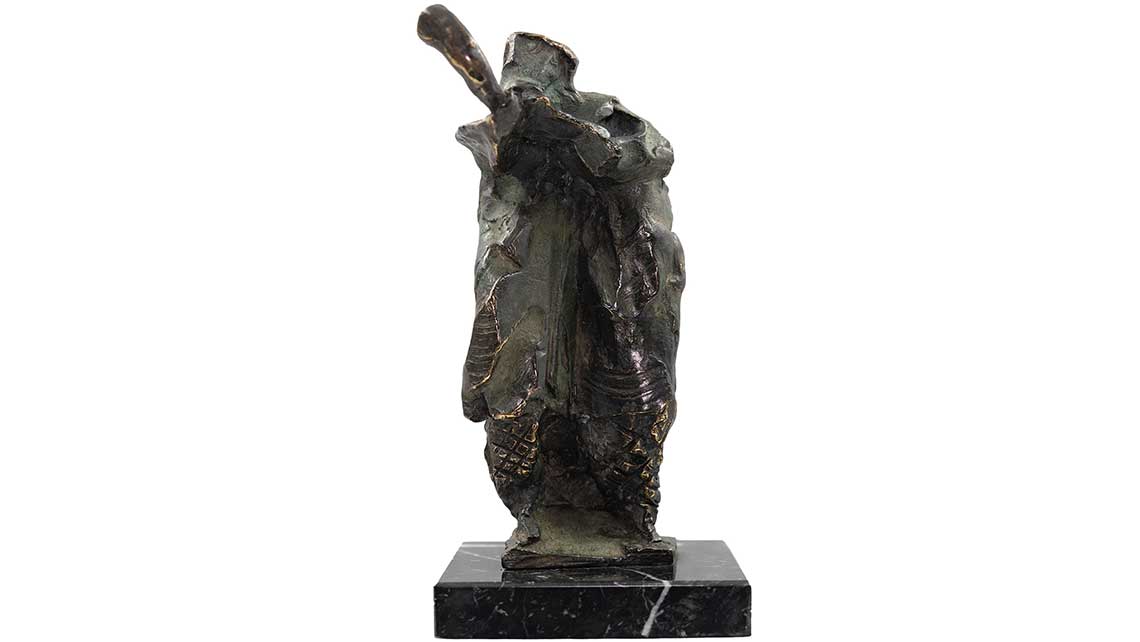
| Characteristics: | Ttuttulari is a freestanding bronze sculpture with a vertical composition. The figure stands upright, gathered around a wind instrument that crosses the upper part of the body and projects to one side through a curved, ascending tube. The anatomy is constructed through broad surfaces, deep cavities, broken edges and volumes of irregular thickness. The face has no individualised features, while arms, torso and instrument merge into a single structure. The patina combines dark greens, browns, bluish nuances and coppery highlights. The densest tones gather in the cavities and protected areas, while the head, instrument, hands and edges recover the warm luminosity of the metal. The work rests on a small bronze base and a rectangular plinth of polished black marble. The geometric stability of the stone contrasts with the irregular silhouette and the instrument’s strong projection into space. |
| Artwork: |
Click to enlarge |
| Description: |
Antonio Oteiza concentrates the work on an essential action: a body draws in air and transforms it into sound. He does not place the performer within a celebration or introduce elements that explain a specific scene. Everything secondary is removed so that attention can focus on the physical relationship between musician, instrument and breath. The figure is organised around a firm vertical axis. The legs remain close together and provide a restrained support, while the upper section broadens and becomes far more complex. From this stable foundation, the instrument moves away from the body and decisively alters the balance of the composition. Its sweeping curve is the first element to attract the eye. It emerges beside the torso, extends to one side and rises until it occupies the space beyond the figure. It does not function as an added object, but as a continuation of the musician and as the visible form of sound being projected outwards. Oteiza does not describe the instrument with technical precision. He constructs it from irregular planes, cavities, folds and edges that merge with the body. This fusion makes it difficult to determine clearly where the performer ends and the instrument begins. The arms participate in this continuity. The hands are barely individualised and are absorbed into the cluster of volumes surrounding the chest. Rather than depicting a specific fingering technique, the sculptor conveys the act of holding, the physical effort and the concentration required to sustain the musical action. The head is reduced to an angular, almost anonymous form. The face offers no recognisable expression and does not identify a particular person. Intensity is located not in the features, but in the inclination of the body, the opening of the upper section and the path followed by the instrument. The cavities around the chest and beneath the curved tube play a fundamental role. They partially separate the volumes, gather shadow and make the circulation of air imaginable. In a sculpture made from solid matter, empty space becomes the sculptural equivalent of breath. The torso descends in broad vertical surfaces crossed by folds, incisions and abrupt changes in thickness. Anatomy and clothing merge into a continuous mass. Oteiza does not seek to imitate the body or reproduce garments accurately, but to express the inner tension that sustains the sound. The lower section remains more enclosed. The narrow, parallel legs stand on a small base integrated into the casting. Their surfaces display lines and reliefs that introduce a visual rhythm and guide the eye from the feet towards the upper part of the sculpture. This opposition between restraint and expansion defines the entire work. The body remains concentrated and rooted, while the instrument opens and advances into space. Music seems to arise precisely from the tension between what is held back and what is finally released. The sculpture changes significantly when viewed from different angles. From the front, the instrument dominates the upper section and directs the composition. In the side views, its depth and its separation from the body’s axis become clearer. From other perspectives, musician and instrument merge into an almost abstract mass. The surface preserves the direct energy of the modelling process. Incisions, depressions, casting ridges and accumulations of material break up the light and resist any uniform finish. The bronze appears as matter under pressure, crossed by an inner force seeking to open outwards. The patina intensifies this perception. Greens and darker tones deepen the cavities, while coppery highlights run along the edges and trace the path of the instrument. As the viewer moves around the work, light continually reconstructs the musical gesture. The black marble plinth introduces a stable, regular and silent plane. Against it, the figure acquires a more dynamic presence and the curve of the instrument appears even more expansive. The support acts as an anchoring point for a composition that seems to extend beyond its actual dimensions. Oteiza avoids turning the musician into a picturesque type. He does not dwell on the description of a face, clothing or a specific circumstance. He reduces the image to its essential forces: the body that breathes, the instrument that extends that body and the air that becomes sound. In Ttuttulari, music is represented not as melody, but as impulse. Antonio Oteiza makes the bronze preserve the tension of the breath and causes immobile matter to appear to expand at the very moment it begins to sound. |