Txalaparta
| Collection: | Music in Bronze (Antonio Oteiza) |
| Author: | Fr. Antonio Oteiza |
| Inventory Number: | MCO-AO-ES-00053 |
| Type: | Sculpture |
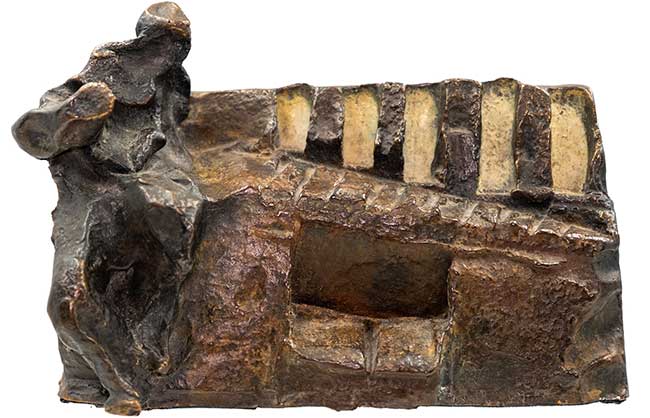
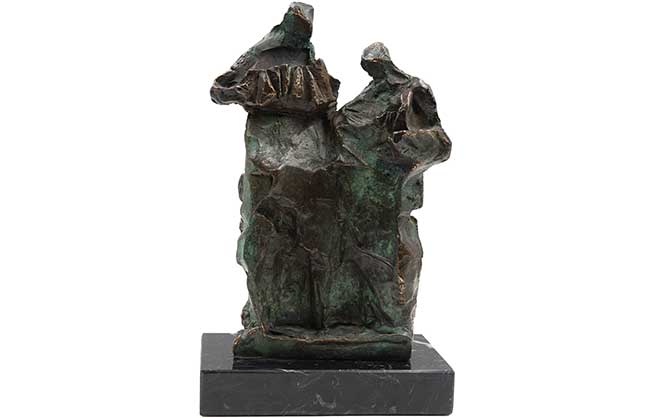
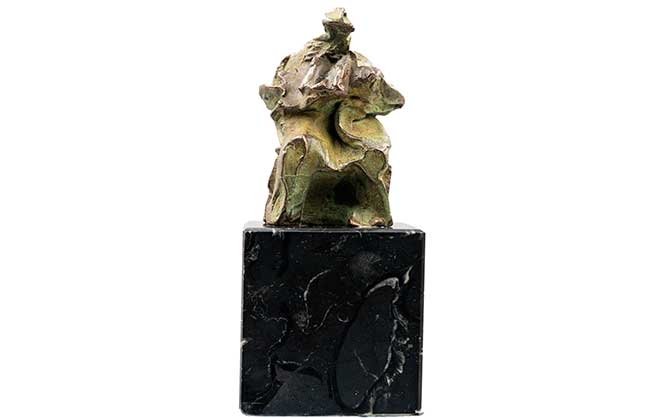
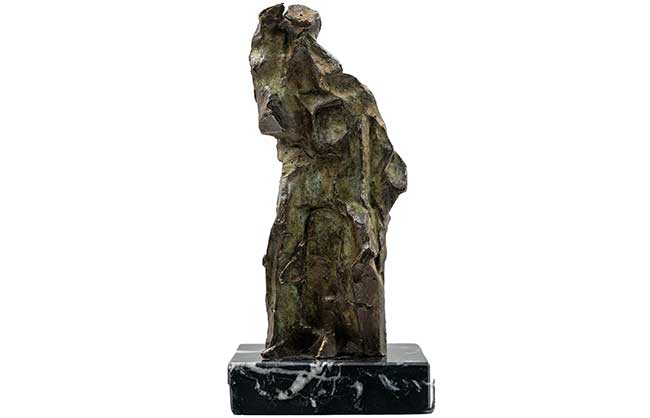
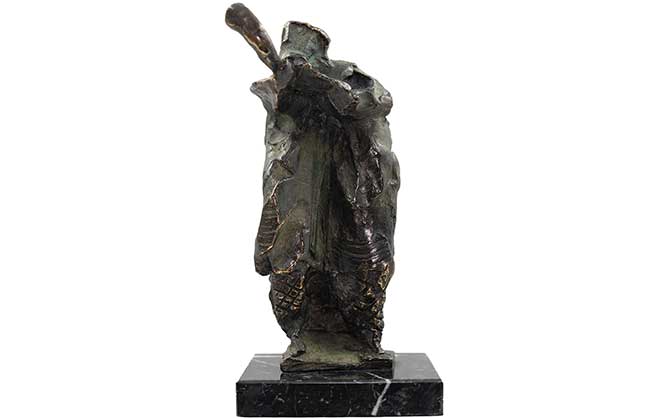
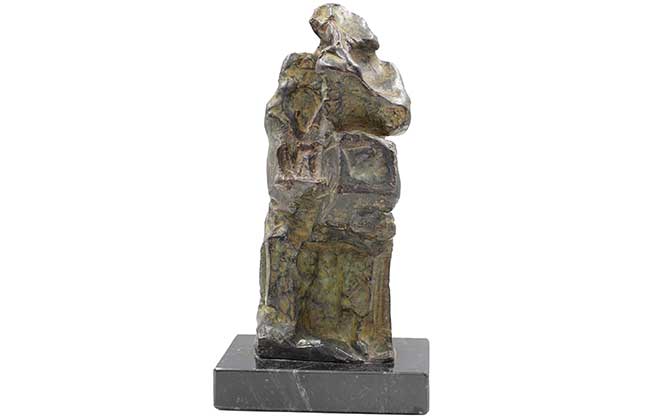
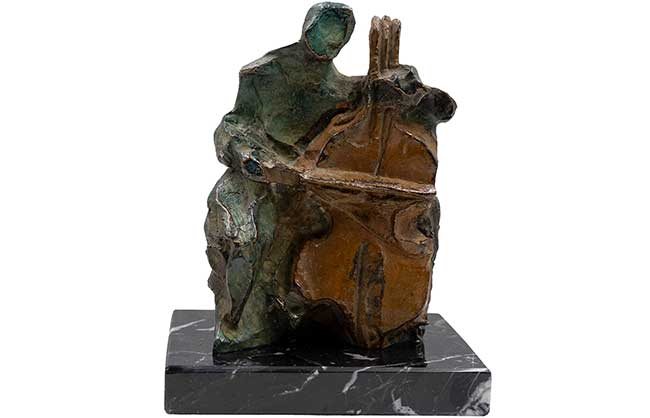
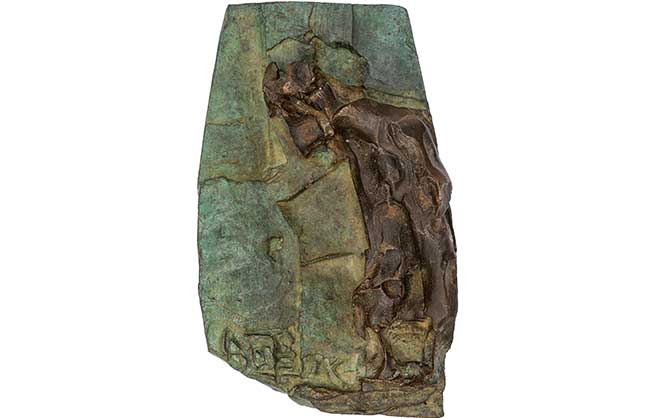
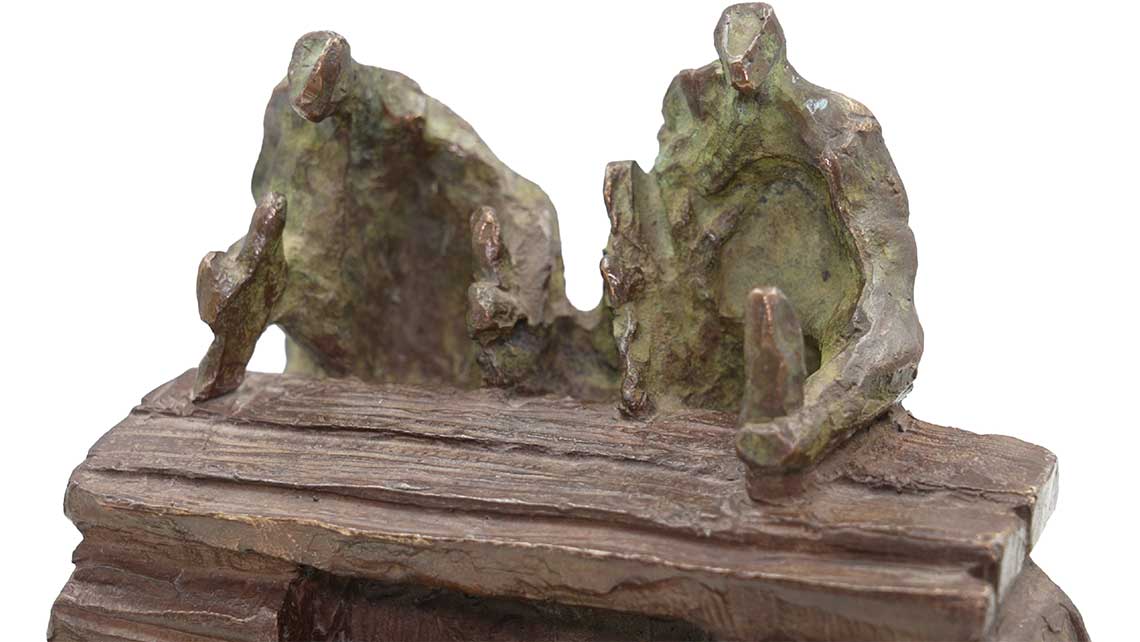
| Characteristics: | Txalaparta is a freestanding bronze sculptural group consisting of two musicians positioned on opposite sides of the instrument. The composition is organised around the horizontal axis of the boards, while the inclined bodies and the makilak introduce vertical and diagonal movements. The figures are reduced to broad planes, concavities and irregular volumes. Their faces have no individualised features, and expression is concentrated in the inclination of the torsos, the position of the arms and the physical relationship both musicians establish with the instrument. The patina combines muted greens, ochres, browns and coppery highlights. Darker tones gather in the cavities and junctions of the bodies, while the edges, heads, arms and makilak recover the warm luminosity of the bronze. The surface of the boards is crossed by longitudinal incisions that evoke the grain of wood and reinforce the horizontal direction of the ensemble. The sculpture rests on a rectangular plinth of polished black marble, whose stable geometry clearly defines the space of the scene. |
| Artwork: |
Click to enlarge |
| Description: |
The txalaparta is a traditional Basque percussion instrument whose performance depends on the coordinated participation of two people. The horizontal boards are struck with vertical wooden sticks known as makilak, and the rhythm is built through a sequence of alternating interventions. Its distinctive character lies not only in the sound of the wood, but also in the relationship between the performers. Each strike listens to, continues or modifies the previous one. The music belongs fully to neither of them: it arises in the shared space they create together. Antonio Oteiza makes this shared dimension the true centre of the sculpture. Neither musician is presented as the protagonist, and no hierarchy is established between them. Both bodies lean towards the instrument and are united by an action that demands attention, precision and reciprocity. The figures stand on either side of the boards and form an open composition. Their curved torsos frame a broad central void, while their heads incline towards the striking surface. The posture conveys concentration, but also an openness towards the other: each musician appears to act while remaining attentive to the response that will follow. Oteiza avoids describing the bodies naturalistically. Anatomy is simplified into concave surfaces, broken edges and masses of varying thickness. Arms, shoulders, clothing and torso merge into continuous forms that preserve the direct energy of the modelling process. The makilak appear in different positions. Some remain raised, while others approach the boards, suggesting different stages of the action. This variation creates a visual sequence comparable to the alternation of the strikes and allows the viewer to imagine rhythm without any actual movement. The contrast between horizontality and verticality structures the entire work. The boards form a long, firm and stable plane; the sticks interrupt that direction with vertical impulses. The bodies, leaning diagonally, connect both movements and guide the eye towards the centre. The void between the musicians has a decisive presence. It is not a separation that isolates them, but the space in which their gestures meet and where the sound seems to spread. Oteiza uses the absence of material to represent the invisible dimension of music. The broad concavities of the bodies reinforce this idea. The figures seem to open towards the instrument and to behave like resonating surfaces. The human form is no longer a closed volume, but becomes part of the sonic event. The txalaparta also acquires an architectural dimension. Its boards and supports create a platform that orders the scene, separates the musicians and, at the same time, brings them together. Beneath the striking surface, a longitudinal opening lightens the base and gives spatial depth to the group. The scene changes when viewed from different angles. From the front, the dialogue between the performers and the sequence of the makilak become especially clear. The side views reveal more fully the inclination of the bodies and the depth of the large concave forms. From the rear, the figures lose part of their narrative character and are perceived as two masses enclosing the central space. The surface preserves incisions, pressure marks, accumulations of material and abrupt shifts of plane. The bronze does not seek to imitate skin, clothing or wood exactly. Instead, it conveys the material intensity of the performance. The longitudinal marks on the boards also suggest wear and the memory of repeated action. The patina helps distinguish the different elements without breaking the unity of the work. Greens and ochres give depth to the figures, while the warmer tones of the boards strengthen the presence of the instrument. Coppery highlights animate the projecting areas and cause the gestures to reappear with every change of light. Oteiza approaches a Basque tradition without turning it into a folkloric genre scene. The txalaparta is presented neither as a picturesque object nor as an isolated relic of the past, but as a living form of communication and collective creation. The work speaks about music, but also about coexistence. To build a rhythm, one must act and leave space, propose and listen, sustain an initiative and accept the response of the other. The symbolic force of the scene lies in this alternation. In Txalaparta, Antonio Oteiza allows the silence of bronze to preserve the inner logic of shared music. The strikes cannot be heard, yet they remain suggested in the position of the makilak, the inclination of the bodies and the relational space that opens between the two musicians. |