Irrintzilari
| Collection: | Music in Bronze (Antonio Oteiza) |
| Author: | Fr. Antonio Oteiza |
| Inventory Number: | MCO-AO-RE-00005 |
| Type: | Relief |
| Location: | Cataloguing Room |
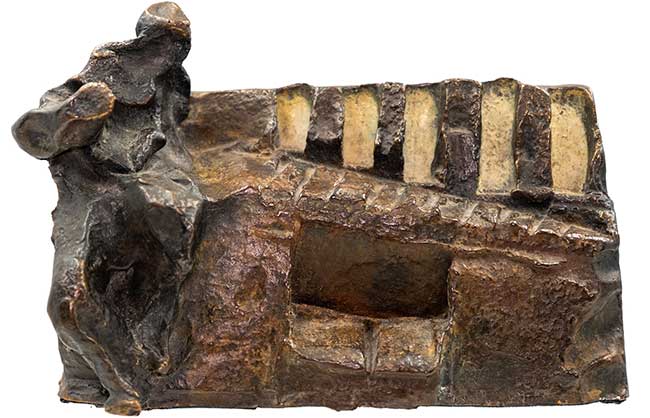
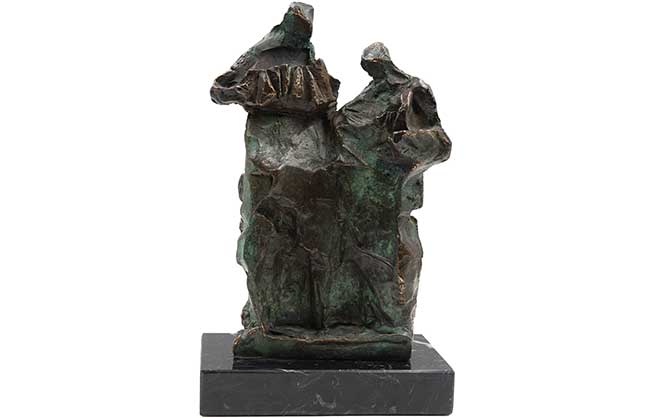
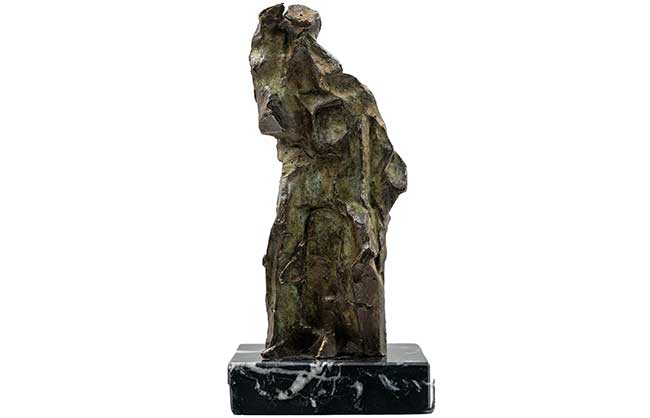
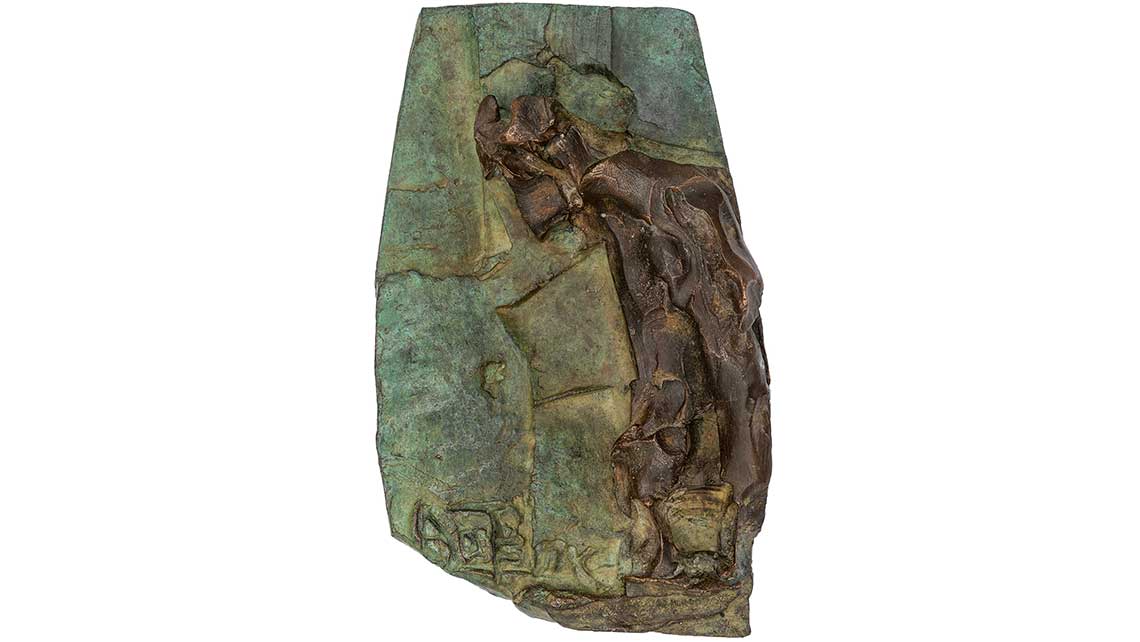
| Characteristics: | Irrintzilari is an autonomous bronze relief with a vertical format and an irregular outline. The figure occupies mainly the right half of the composition and develops along a pronounced ascending diagonal, while the broad surrounding field acts as the space into which the gesture is projected. The body is constructed through broken planes, concavities, edges and volumes of varying depth. The head tilts backwards, the arms gather around the face and the torso appears to open from within. Oteiza abandons naturalistic description in order to express the physical tension of the irrintzi. The patina establishes a clear contrast between the greens, muted turquoise and ochres of the background and the brown, dark and coppery tones of the figure. This chromatic distinction strengthens the body’s emergence from the plane and allows the raised areas to respond intensely to light. The surface preserves incisions, roughness, small cavities, accumulations of material and abrupt shifts in level. The relief is not enclosed by a frame: its irregular edges keep the material character of the casting visible and reinforce the work’s autonomy. |
| Artwork: |
Click to enlarge |
| Description: |
The irrintzi is a high, prolonged cry deeply rooted in Basque culture. It is heard at festivals, gatherings and moments of collective expression, yet its force extends beyond tradition alone. It begins in a particular body, crosses the air and is directed towards others. It is an individual voice and, at the same time, a shared call. Antonio Oteiza explored this subject both in freestanding sculpture and in relief. The existence of both versions reveals how the same theme can lead to different sculptural solutions. In the freestanding work, the cry expands around a body fully developed in space; in this relief, it must force its way out from within a surface. This condition determines the entire composition. The figure is not simply laid over a background, but emerges from it with varying intensity. Some areas remain closely attached to the plane, while others project forcefully forward and cast their own shadows. The body therefore occupies an intermediate state between image and volume. The ascending diagonal is the principal expressive device. From the lower section, the figure rises, leans backwards and culminates in the head. This direction breaks the vertical stability of the format and conveys the sensation of an impulse that cannot remain contained. The head forms the point of greatest tension. It is raised and thrust backwards, yet no detailed physiognomy is given. Oteiza does not need to depict an open mouth literally. The position of the neck, the retreat of the face and the opening of the torso are enough to make the release of the voice imaginable. The arms gather around the upper body. One rises towards the head, while the other folds across the torso. Their purpose is not to describe an academically precise gesture, but to concentrate energy at the point where breath, effort and sound come together. The torso is organised as a diagonal, irregular and fragmented mass. In some areas it projects with considerable depth; in others it merges into the greenish field. Anatomy ceases to be a closed structure and becomes a system of forces that seem to press the bronze from within. The legs and feet provide a more stable support. Located in the lower right section, they sustain the upward development of the figure and establish a firm relationship with the band running along the base. Oteiza thus sets the rootedness of the body against the expansion of the voice. The background plays a decisive role. It is neither a neutral wall nor a mere support for the figure. Its changes in relief, divisions and broad patinated areas transform the field into an active space capable of receiving and extending the impulse of the irrintzilari. The chromatic contrast intensifies this relationship. The greens and turquoise tones of the background create a broad, almost mineral atmosphere, while the browns and coppery tones bring the figure visually forward. The body seems to detach itself from the plane and move towards the viewer. Light completes this transformation. When it strikes the edges of the head, arms, torso and legs, it activates the warm reflections of the metal. Dense shadows, by contrast, gather in the cavities. The image changes according to the lighting and the position from which it is viewed. The texture preserves the immediate energy of the modelling process. Cuts, abrasions, irregular edges and accumulations of material prevent the surface from becoming uniform. The bronze seems subjected to an inner pressure similar to that which passes through the body before the cry is released. Oteiza removes any narrative setting. There are no spectators, landscape, detailed garments or festive references. The irrintzilari is reduced to the essential action of breathing, tensing and projecting the voice. This absence of anecdotal detail distances the work from folkloric representation. The subject retains its Basque roots, but acquires a broader dimension. The cry may be understood as affirmation, celebration, summons or the need to make one’s presence felt before others. The composition also explores the relationship between matter and sound. Bronze belongs to the realm of the solid, heavy and enduring; the irrintzi, by contrast, is invisible, crosses space and disappears as it is produced. Oteiza brings these opposing realities together by fixing in matter the bodily effort that makes the voice possible. The relief version offers a particularly intense reading of this contradiction. Sound seems to originate within the surface and force it to open. The figure does not merely emerge from the background; it disturbs its stability and turns the entire field into a resonating space. In Irrintzilari, Antonio Oteiza makes visible both the instant before the cry spreads and the beginning of its expansion. The work remains still and silent, yet the rising body, the tension of the planes and the rupture of the background preserve the force of a voice that seems to continue beyond the limits of the bronze. |