Crosscut Sawyers
| Collection: | Trades in Bronze (Antonio Oteiza) |
| Author: | Fr. Antonio Oteiza |
| Inventory Number: | MCO-AO-ES-00038 |
| Type: | Relief |
| Location: | Cataloguing Room |
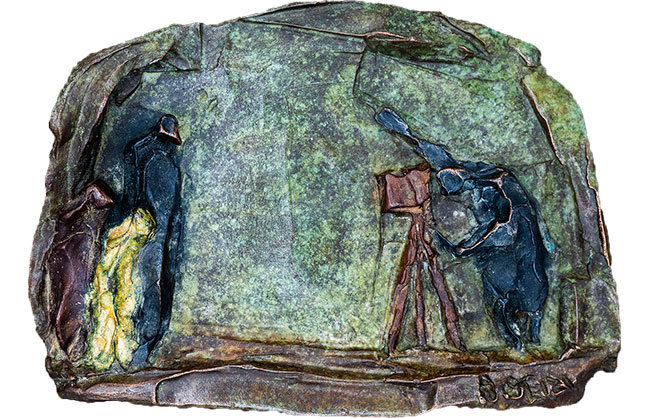
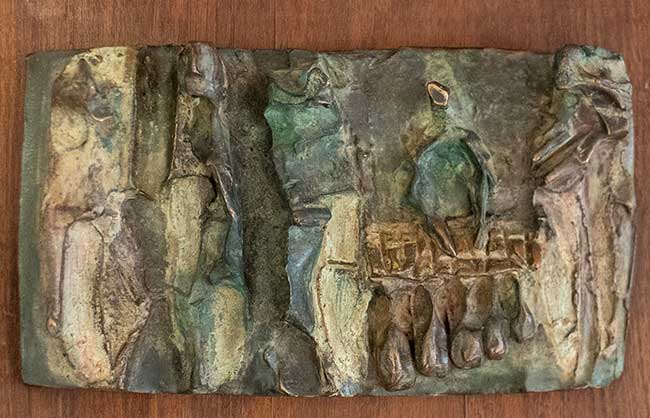
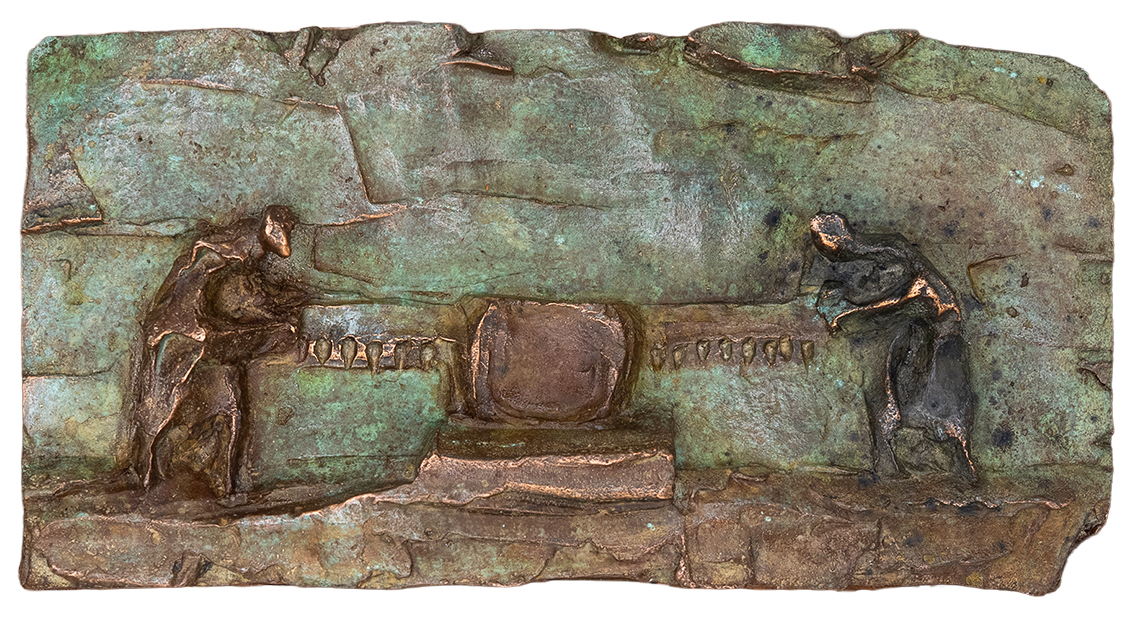
| Characteristics: | Crosscut Sawyers is a horizontal relief structured around two figures placed at opposite ends of the composition. A long toothed saw stretches between them, linking the workers both physically and visually. Their bodies lean towards the tool and are modelled through compact, simplified forms. Rough surfaces and a patina combining green, brown and black tones with copper highlights distinguish the figures from the background and emphasise the central block of wood on which they are working. |
| Artwork: |
Click to enlarge |
| Description: |
Working with a long crosscut saw required far more than physical strength. Each man had to pull the blade towards himself and then release the movement so that his partner could complete the return stroke. Any loss of rhythm could slow the cut or cause the saw to catch. The task depended on experience, coordination and a precise understanding between the two workers. Antonio Oteiza builds the scene around this mutual dependence. The men occupy the outer edges of the relief, separated by the timber yet joined by the same tool. Both bodies incline towards the centre, concentrating their effort on the material that resists them. The saw forms the main axis of the composition. Its horizontal line runs across almost the entire work, while the clearly defined sequence of teeth makes the hardness of the cutting process visible. The compact central volume holds the figures apart, but also binds them to a single action. The sculptor removes anything unnecessary. Faces and surroundings are only suggested, allowing posture, distance and tool to carry the meaning of the scene. The uneven surface and varied patina give the relief a strong physical presence, recalling both the roughness of the wood and the strain of the labour. Crosscut Sawyers preserves the memory of a profession largely displaced by mechanisation. At the same time, the work speaks of something enduring: trust, coordinated effort and the ability to turn two separate forces into one continuous movement. |